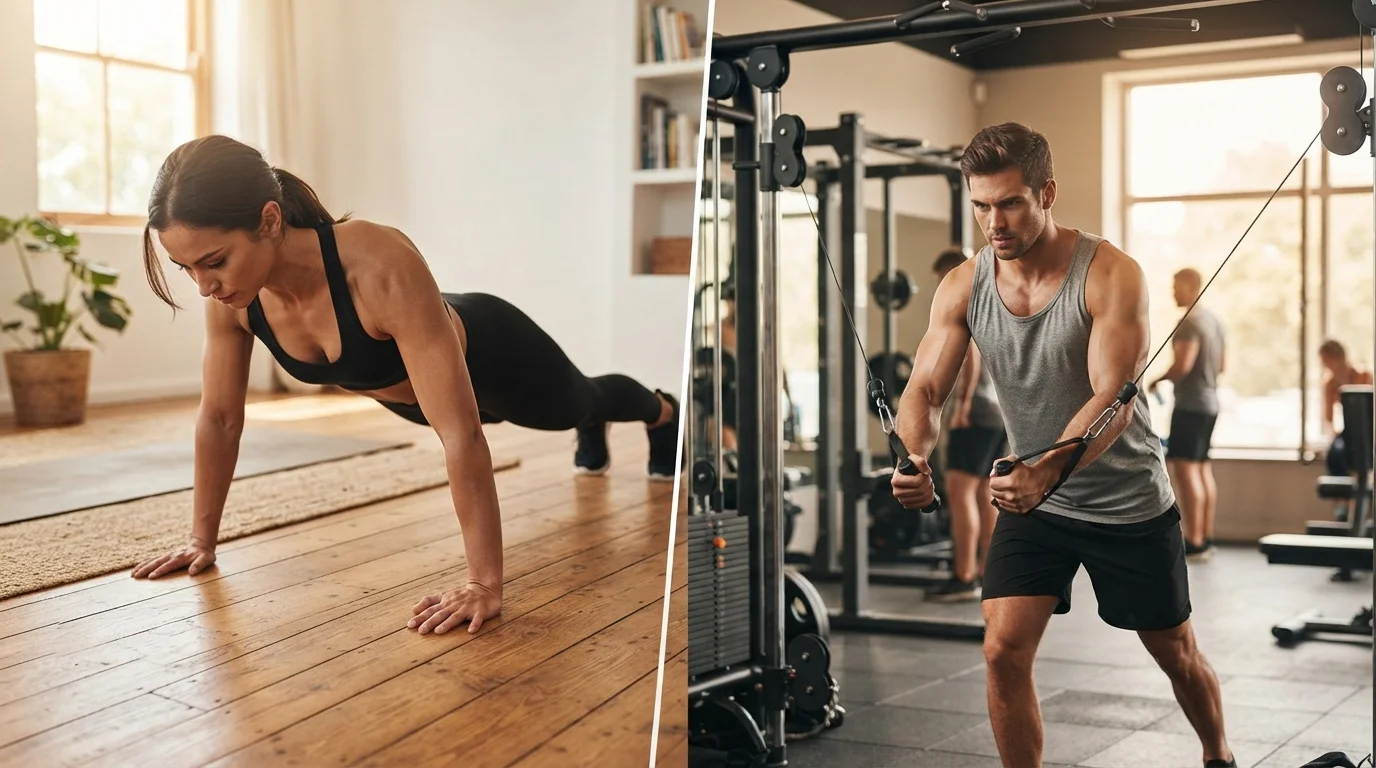
The Core Principles That Never Change
No matter which method you choose, the physiology of getting fitter doesn't shift. The body adapts to progressive overload — meaning you need to gradually increase the demand placed on muscles over time, whether that demand comes from a heavier barbell or a more challenging bodyweight variation. Recovery, sleep, and nutrition remain equally critical regardless of your training environment.
This matters because a common misconception frames gym equipment as inherently superior. In reality, as research on long-term fitness outcomes supports, the training you perform consistently over months and years drives results far more than the specific tool you use on any given day.
| Criterion | Bodyweight Training | Gym Equipment Training |
|---|---|---|
| Cost | Free / minimal | Membership or equipment fees |
| Accessibility | Anywhere, anytime | Requires gym or home setup |
| Load precision | Approximate (leverage-based) | Exact (measurable increments) |
| Isolation exercises | Limited options | Wide range available |
| Balance & stability training | Naturally integrated | Often requires extra focus |
| Beginner accessibility | High — low skill barrier | Moderate — technique learning |
| Advanced progression | Possible but requires creativity | Straightforward via added load |
Where Gym Equipment Has a Genuine Edge
Gym equipment does offer measurable advantages in specific contexts. Adding a 2.5-pound plate to a barbell is a precise, repeatable progression that bodyweight training can only approximate. For people with goals tied to maximal strength sports, bodybuilding-level hypertrophy, or rehabilitation protocols, that precision matters.
Isolation exercises — leg curls, cable flyes, lat pulldowns — also target muscles that are genuinely difficult to load with bodyweight alone. The upper back and hamstrings, in particular, respond well to equipment-based resistance. Machines can also reduce the technical skill required to train safely, lowering injury risk for movements that have steep learning curves when performed with free weights.
~Equal
Strength gains: bodyweight vs. free weights
A review published in the Journal of Human Kinetics found comparable strength improvements between bodyweight and resistance-training programs when volume and progressive overload were equated.
80%
Adults who don't meet activity guidelines
The CDC estimates roughly 80% of American adults do not meet both aerobic and muscle-strengthening physical activity guidelines — suggesting access and habit matter more than equipment type.
Where Bodyweight Training Holds Its Own
Bodyweight training is not a beginner-only category. Exercises such as single-leg squats, archer push-ups, and hanging leg raises are demanding enough to challenge advanced athletes. Because the load is the body itself, these movements inherently develop balance, proprioception (body-position awareness), and joint stability — qualities that gym machines don't always train.
The accessibility factor is significant and shouldn't be underestimated. A hotel room, a park, or a living-room floor is enough space to complete an effective workout. Eliminating commute time, membership costs, and equipment dependency removes the friction that causes many people to abandon exercise routines. As explored in common fitness myths that hold people back, the belief that training must be elaborate or equipment-heavy is one of the barriers that keeps many people sedentary.
A Note on Special Populations
Older adults, those managing chronic conditions, and people recovering from injury should seek guidance from a qualified healthcare provider or certified fitness professional before choosing a training approach. Both bodyweight and equipment-based exercise can be adapted for a wide range of abilities, but individual needs vary significantly. What works well for one person may not be appropriate for another.
Progression: The Real Difference in Practice
Progressing with gym equipment is often more straightforward in early and intermediate stages — add weight, track the number, repeat. Progressing with bodyweight requires more creativity: adjusting leverage, changing tempo, reducing stability, or adding single-limb variations. Neither approach is harder to progress; they just look different.
A practical middle path that many people find effective is combining both — using bodyweight training as the default for consistency and convenience, and supplementing with gym sessions when schedule and access allow. This hybrid approach preserves the habit while capturing the load-progression benefits of equipment when available. The goal isn't methodological purity; it's durable, health-supporting physical activity that fits your actual life.
This article is for general informational and educational purposes only and is not a substitute for professional medical or fitness advice. Consult a qualified healthcare provider or certified fitness professional before beginning any new exercise program, especially if you have existing health conditions or injuries.