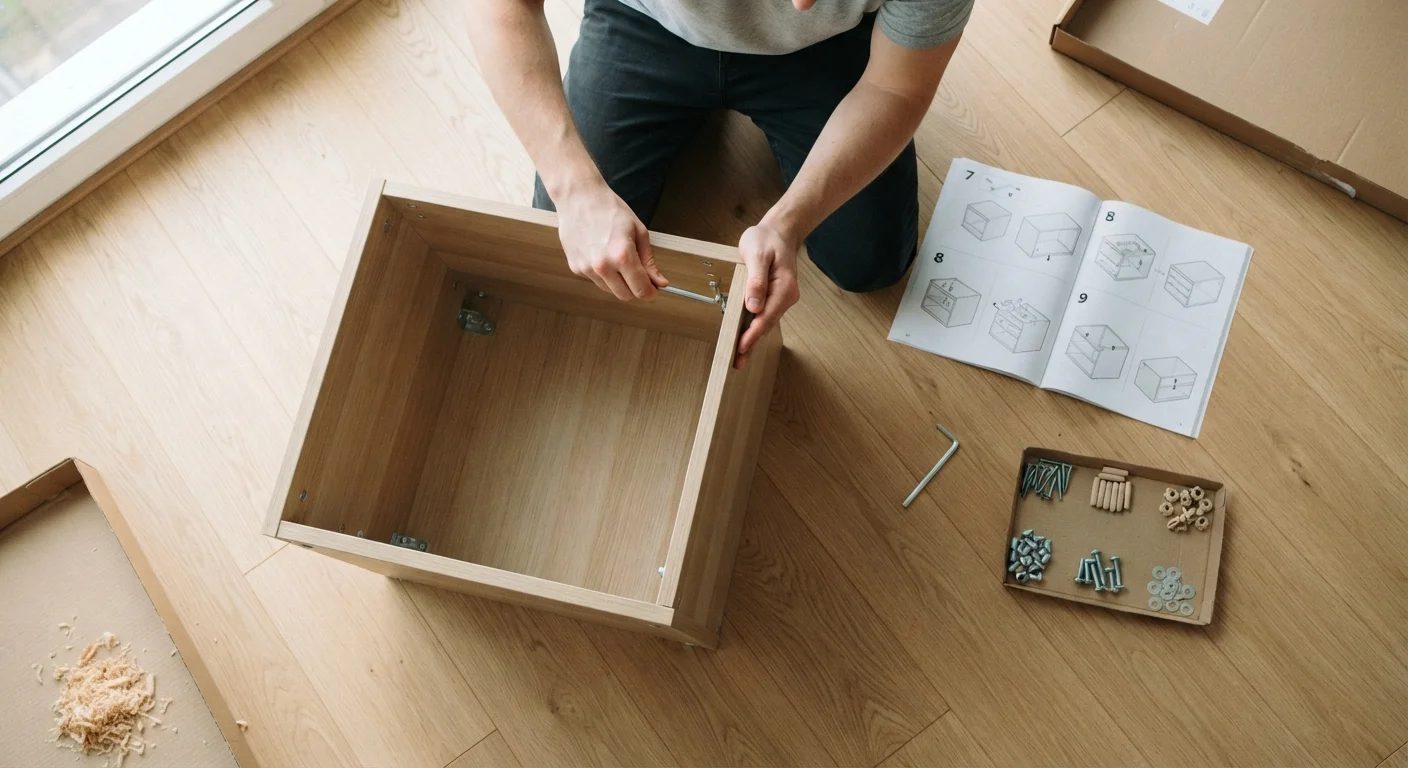
Why Flat-Pack Furniture Wobbles in the First Place
Flat-pack furniture is engineered with tolerances tight enough that, assembled correctly, the finished piece can be genuinely rigid. The wobble most people experience is almost always the result of small assembly errors compounding — not a fundamental flaw in the design or materials. Particleboard and MDF panels rely on precise joint geometry to achieve stability; when even one cam lock is under-engaged or one panel is slightly out of square, the entire structure loses its triangulated rigidity and begins to rack.
Understanding this helps reframe the task. You are not fighting cheap materials — you are working with a system that rewards patience and sequence. The mistakes below are the ones that most consistently undermine an otherwise sound piece of furniture.
Tightening each fastener fully as you go, before the full structure is assembled.
Why it happens: It feels logical to secure each connection before moving on, and loose pieces during assembly are frustrating to manage.
Skimming the instructions and relying on intuition after the first few steps.
Why it happens: Many steps look nearly identical, and experienced assemblers assume they can extrapolate. Some panels are asymmetrical in ways that are not obvious until a door refuses to hang.
Assembling on carpet or an uneven surface.
Why it happens: The living room floor is convenient, and carpet feels protective against scratches.
Failing to fully seat dowels and cam-lock barrels before closing the joint.
Why it happens: Dowels and barrel nuts look seated when they are only partially inserted, and it takes real hand pressure — or a mallet tap — to drive them the rest of the way.
Skipping the final squaring check before the last tightening pass.
Why it happens: The piece appears square visually, and assemblers are eager to finish.
Using a power drill at full torque on particleboard fasteners.
Why it happens: Power tools speed things up, and it is tempting to use the same settings as for wood screws.
The Assembly Habits That Make Results Last
Beyond avoiding specific errors, a handful of consistent habits lift the quality of every flat-pack build significantly.
Never Ignore Structural Hardware
Cam locks, barrel nuts, and confirmat screws are structural — they are not decorative finishing details. Skipping or under-tightening even one of these fasteners can cause a shelf or cabinet to rack and fail under normal load. Always complete every fastener called out in the instructions, even if the piece feels stable before you finish.
Work in stages, not in bursts. Lay out all hardware before you start and sort it by type. The few minutes spent organizing saves the frustration of hunting for a single cam lock under a half-assembled cabinet. Keep the instruction sheet flat and visible — do not fold it.
Use the right tools lightly. The included Allen key is sized for the torque particleboard can handle. If you use a longer Allen key for extra leverage, you risk overtightening. A rubber mallet, a tape measure, and a flat working surface complete the toolkit for the vast majority of builds.
Stripped Cam Locks Cannot Be Easily Reversed
Overtightening a cam lock cracks the surrounding particleboard, creating a joint that can never grip firmly again. Turn cam locks only until they snug firmly — usually a quarter turn past the point of resistance. If you feel gritty crunching while turning, stop immediately and back off slightly.
Square last, tighten last. Once all panels and fasteners are hand-tight, stand back and assess the frame visually, then measure diagonally. Squaring now — before the final tightening pass — takes less than two minutes and is the single highest-impact step you can take for long-term stability. A piece squared at this stage and fully tightened will remain true through years of normal use.