More Than a Reminder System
Most drivers think of a maintenance log — if they think of it at all — as a simple prompt to schedule the next oil change. In practice, a thorough service record does something far more consequential: it builds a verifiable narrative of how a vehicle has been treated across its entire lifespan.
That narrative matters in ways that aren't immediately obvious. It informs the mechanic inspecting an unfamiliar car, it reassures a potential buyer, and it can even influence how warranty claims are assessed. A well-kept log is a form of documentation that protects your interests every time the car changes hands or lands in a service bay.
Regular service paired with consistent record-keeping is closely tied to long-term reliability. Knowing that fluids were changed on schedule, that brake inspections were conducted, and that previous issues were properly resolved removes guesswork at every future service visit. See our guide to DIY checks vs. professional servicing for a clearer picture of which tasks belong in a shop and which you can handle yourself.
Warranty and Recall Considerations
Some manufacturer and extended warranties require proof that the vehicle was serviced at recommended intervals to honour certain claims. While requirements vary by warranty type and provider, a complete maintenance log is generally the clearest way to demonstrate compliance. Always review your specific warranty terms and consult the provider directly if a claim situation arises.
How Records Affect Resale
When the time comes to sell or trade in a vehicle, the service log becomes a tangible asset. A buyer evaluating two similar cars — same make, model, year, and mileage — will almost always prefer the one with a documented history. That preference reflects a rational calculation: documented care is verifiable; undocumented care is an unknown risk.
Gaps in a log raise questions that sellers often can't answer adequately. Was the transmission serviced? Were the brakes replaced on time? Without records, neither party can be certain. Complete documentation shifts the burden of proof in the seller's favour and reduces the negotiating leverage a buyer holds when pointing to uncertainty.
Up to 40%
Potential impact of missing service records on resale negotiations
Industry estimates from automotive appraisal professionals suggest that absent or incomplete service history can significantly reduce a vehicle's perceived value during private sales and trade-in assessments.
3 in 10
Used-car buyers who cite service history as a top purchase factor
Consumer surveys conducted by used-vehicle market researchers consistently find that documented maintenance history ranks among the most important factors buyers weigh when evaluating a private-party or dealer listing.
Keeping receipts from every oil change, tire rotation, and inspection visit costs nothing beyond the habit of filing them. Over several years, that small habit can meaningfully support the vehicle's market position.
Practical Value in the Service Bay
A maintenance log also has immediate, practical utility every time your car is serviced. Mechanics working on an unfamiliar vehicle — whether at a dealership or an independent shop — benefit enormously from knowing what was done previously. It prevents duplicate work, helps identify parts nearing the end of their service life, and can speed up diagnosis when something goes wrong.
Consider an unusual noise that develops gradually. A technician reviewing your log can cross-reference recent work, identify what was last inspected, and narrow down likely causes without starting from scratch. For more on interpreting those kinds of signals, see our guide to car noises and what they mean.
Set a Recurring Reminder to Update Your Log
After every service appointment, take two minutes to add the entry before leaving the lot or driveway. Setting a recurring reminder on your phone tied to your typical service interval — every three months or every 5,000 miles, for example — helps prevent gaps from forming. Consistency is more important than the format you choose.
Proactive record-keeping also helps you stay ahead of manufacturer-recommended intervals. Vehicles have dozens of components on separate replacement schedules — timing belts, coolant flushes, spark plugs — and a log makes it straightforward to track where each one stands. Pair this habit with seasonal maintenance checks to address condition-specific wear before it becomes a problem.
Building the Habit: What and How to Document
Starting a maintenance log requires no special tools. A dedicated folder for receipts, a simple notebook kept in the glove compartment, or a free smartphone app all serve the purpose. The most important factor is consistency — logging every service event, no matter how minor.
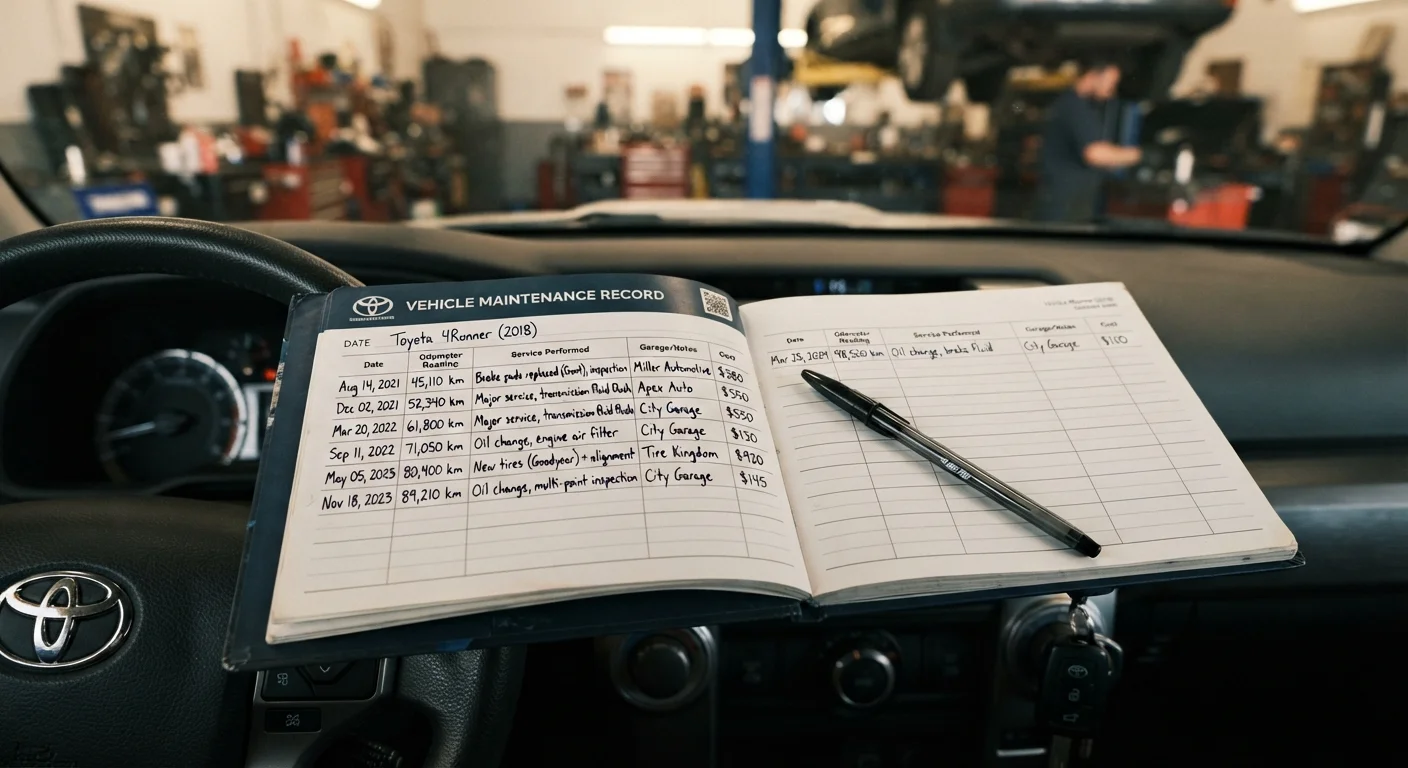
Each entry should include the date, odometer reading, the service performed, parts used or replaced, and the name of the shop or technician. Attach or photograph the original receipt wherever possible. If you handle a minor task yourself — checking tyre pressure, topping off washer fluid — a brief note is still worth making.
Before a long drive, a complete log also doubles as a quick reference to confirm that the vehicle is within all recommended intervals. Our pre-departure vehicle checklist pairs well with a current log, helping you identify anything due before hitting the highway.
The habit is straightforward to establish, and its value compounds over time. Every entry you make today is information that could protect you — financially, mechanically, and legally — at any point in the vehicle's future.