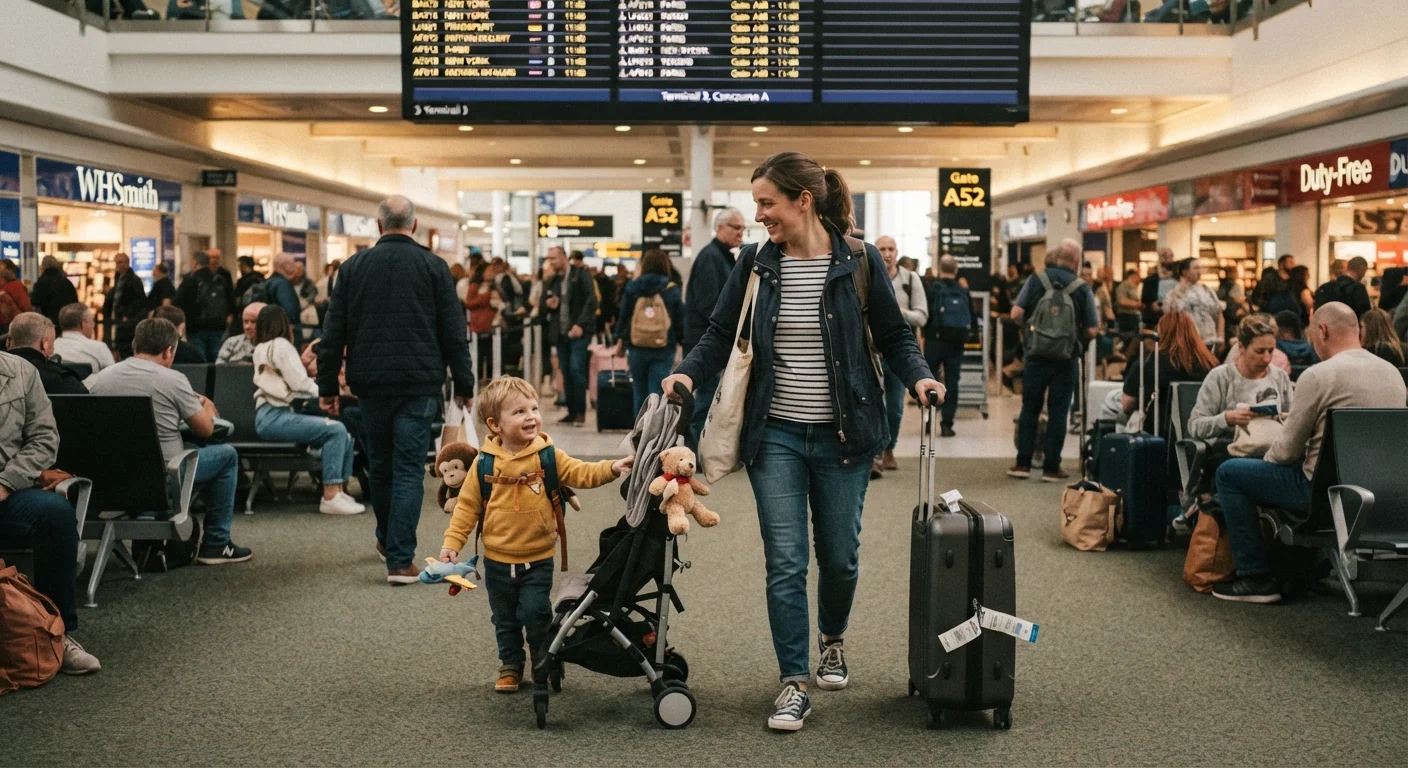
Why Flying With Kids Gets Harder Than It Should
Flying with a toddler or young child isn't inherently chaotic — but it becomes that way when the planning assumptions adults use for solo travel get applied to a family trip without adjustment. The gap between how flights work and how young children work is where most of the friction lives.
If you're mapping out your first flight with kids, the calm starting-point guide for first family vacations is worth reading before you even open a booking tab. The principles of pacing and realistic expectations apply just as much in the air as on the ground.
Below are the mistakes that consistently make flights with young children harder than they need to be — and what to do instead.
Booking the cheapest flight without checking connection time or airport size.
Why it happens: Adults traveling alone can hustle between gates in 25 minutes with carry-on only. Parents assume the same applies with a stroller, a toddler, and a diaper bag.
Choosing flight times based on price rather than the child's sleep schedule.
Why it happens: Early-morning or late-night flights are often cheaper and tempting, but they collide directly with the hours young children are hardest to manage when overtired.
Underpacking entertainment and snacks for the total travel day, not just flight duration.
Why it happens: Parents calculate snacks and activities for the flight length, forgetting that check-in, security, boarding, deplaning, and baggage claim can add three or more hours to the day.
Not practicing the security process before the first family flight.
Why it happens: Security feels self-explanatory to experienced travelers, but collapsing a stroller, removing a child from a carrier, pulling out liquids, and managing a toddler simultaneously is a four-handed job that benefits from rehearsal.
Failing to pre-arrange car seat logistics at the destination.
Why it happens: Car seats feel like a rental-car problem to solve on arrival, but availability is often limited, add-on costs are high, and seat condition and compatibility aren't guaranteed.
Bringing a stroller that doesn't gate-check smoothly.
Why it happens: Families use their everyday stroller without realizing bulkier models create friction at the gate, won't fit in overhead bins for storage, and take longer to retrieve at the jet bridge.
The Logistics Details That Derail Even Well-Prepared Families
Most of the mistakes above share a common thread: they stem from treating flight day as the beginning of trip planning rather than its endpoint. The families who board looking calm and ready typically locked in the details weeks earlier.
3+ hrs
Extra time beyond flight duration on a typical travel day
When accounting for check-in, security, boarding, and baggage claim, the actual travel day with young children often runs three or more hours longer than the scheduled flight.
90 min
Recommended minimum connection time for families
Travel logistics experts and frequent family travelers broadly recommend at least 90-minute connections when traveling with children and strollers to avoid missed flights.
Car seat logistics deserve particular attention. Many families assume a rental car will include an appropriate seat, then discover limited availability, high add-on fees, or seats that don't fit their child's age and weight range. Confirming seat type and reservation well ahead of arrival eliminates this pressure entirely. The family pre-travel planning checklist includes a car seat section that's easy to overlook until it's too late.
Airline Policies on Car Seats Vary
Not every airline handles child safety seat check-in the same way — some allow free gate-checking while others count it toward baggage allowances. Policies also differ on which FAA-approved seats are permitted on board. Always verify directly with your airline before travel rather than assuming standard rules apply.
Finally, if you find yourself weighing whether to fly at all versus taking a road trip, know that both come with real trade-offs worth thinking through. Road trips with kids have their own success formula — and comparing the two honestly helps families pick the mode that fits their child's temperament and the trip's distance.
This article is for general informational purposes only. Travel conditions, airline policies, and airport layouts can change — always verify details directly with your airline and relevant authorities before travel.