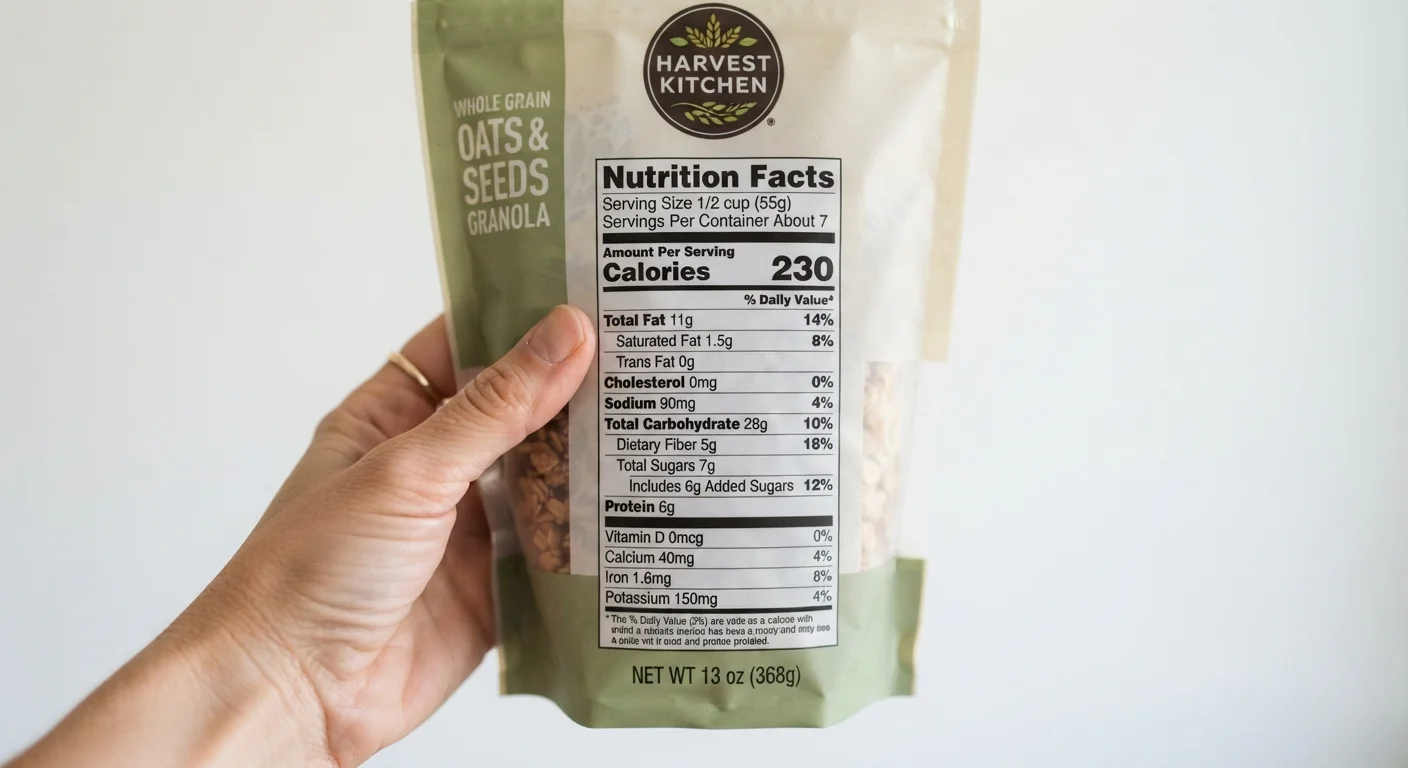
Why Nutrition Labels Exist — and What They Actually Show
The Nutrition Facts label found on packaged foods in the U.S. is regulated by the Food and Drug Administration (FDA). Its purpose is straightforward: to give consumers standardized, comparable information about what they're eating. Yet for many people, the numbers feel more overwhelming than helpful.
Understanding the label doesn't require a nutrition degree. It requires knowing which sections to look at, in what order, and what the numbers actually represent in the context of a full day of eating. Once you have that framework, label-reading becomes a quick, confident habit rather than a confusing chore.
This guide also pairs well with our overview of macronutrients if you want to understand what carbs, protein, and fat are actually doing in your body beyond their gram counts.
What you will need
Step-by-Step: How to Read a Nutrition Label
Follow these steps each time you pick up a packaged product. With practice, the process takes under 30 seconds.
Start with the serving size
The very first line under "Nutrition Facts" shows the serving size and the number of servings per container. Every number on the label — calories, fat, sodium, everything — applies to that single serving, not the whole package.
If a bag of chips lists a serving size of 1 oz (about 28g) but you eat 2 oz, you need to double every value on the label. Many people overlook this step and significantly underestimate their intake as a result.
Check the calorie count per serving
Calories represent the energy a serving provides. This number is prominently displayed and is most useful when viewed relative to the serving size you identified in Step 1.
Calorie needs vary significantly by individual based on age, sex, activity level, and health status. The FDA uses a general reference of 2,000 calories per day for % Daily Value calculations, but this is a benchmark, not a prescription. Consult a healthcare professional for guidance specific to your needs.
Scan the nutrients to limit
Below the calorie count, you'll find nutrients that many people in the U.S. consume in excess: saturated fat, trans fat, sodium, and added sugars. These are worth keeping an eye on, particularly if you eat a lot of packaged foods throughout the day.
- Saturated fat: Current dietary guidance generally recommends limiting saturated fat. Check the % DV (explained in the next step).
- Trans fat: Artificial trans fats have been largely removed from the U.S. food supply, but a label can still legally show 0g if the amount per serving is below 0.5g. Scan the ingredient list for "partially hydrogenated oil" to confirm.
- Sodium: Many packaged foods are high in sodium. The % DV is a useful quick check here.
- Added sugars: These are sugars introduced during processing, separate from naturally occurring sugars in fruit or dairy. Higher added sugar content with little fiber or protein is a common pattern in ultra-processed foods.
Use % Daily Value as your quick benchmark
The % Daily Value (% DV) column on the right side of the label tells you what percentage of a daily recommended amount one serving provides, based on a 2,000-calorie reference diet.
A practical rule of thumb from the FDA: 5% DV or less is considered low for a nutrient; 20% DV or more is considered high. Use this to quickly assess whether a product is a significant source of any given nutrient — helpful or harmful.
For nutrients you want more of (fiber, vitamins, minerals), aim for higher % DVs. For nutrients to limit (sodium, saturated fat, added sugars), lower % DVs per serving are generally preferable. Learn more about the vitamins and minerals behind these values in our micronutrients overview.
Read the ingredient list from top to bottom
Flip to the ingredient list and scan the first three to five ingredients. Since ingredients are listed by weight in descending order, those at the top make up the bulk of the food. Look for:
- Whole grains listed as the first grain ingredient (e.g., "whole wheat flour" rather than just "wheat flour")
- Added sugars appearing under multiple names — sucrose, high-fructose corn syrup, cane juice, dextrose, and maltose are all forms of added sugar
- Shorter ingredient lists, which often — though not always — signal less processing
A long ingredient list isn't automatically a red flag (some multi-ingredient foods are nutritious), but understanding what's in it gives you real information to work with.
Make It a Habit at the Store
Before you add a new packaged product to your cart, take 15–20 seconds to run through serving size, % DV for sodium and saturated fat, and the first few ingredients. Over time this becomes automatic. Comparing two similar products side by side using this method is one of the most practical applications of label literacy.
Understanding Ingredient Lists and Front-of-Package Claims
The Nutrition Facts panel tells you how much of various nutrients a food contains. The ingredient list tells you what the food is actually made from — and the two together give you a much fuller picture.
Ingredients are listed in descending order by weight. If refined flour or added sugar appears in the first two or three spots, those ingredients dominate the product. Conversely, a food that lists a whole grain or a protein source first tends to have a more nutrient-dense foundation.
Front-of-package claims like "low fat," "natural," or "multigrain" are marketing language and are not always meaningful indicators of overall nutrition quality. A food labeled "low fat" may be high in added sugar. "Multigrain" simply means multiple grain types were used — not that any of them are whole grains. Always verify these claims against the actual label.
Front-of-Package Claims Are Not Regulated the Same Way
Terms like "natural," "artisan," or "wholesome" have no strict FDA definition and are largely marketing language. Even regulated terms like "low sodium" or "reduced fat" mean less than they seem — a "reduced fat" product is only required to have 25% less fat than the original version, which may still be a significant amount. Always check the actual Nutrition Facts panel and ingredient list rather than relying on front-of-package messaging.
For a deeper look at how processing levels affect food quality beyond the label, see our article on whole foods vs. processed foods. And if you're looking to apply this knowledge in real life, eating well on a busy schedule offers practical strategies that don't require constant label analysis.
This article is for general informational and educational purposes only. It is not a substitute for personalized advice from a registered dietitian or qualified healthcare professional.