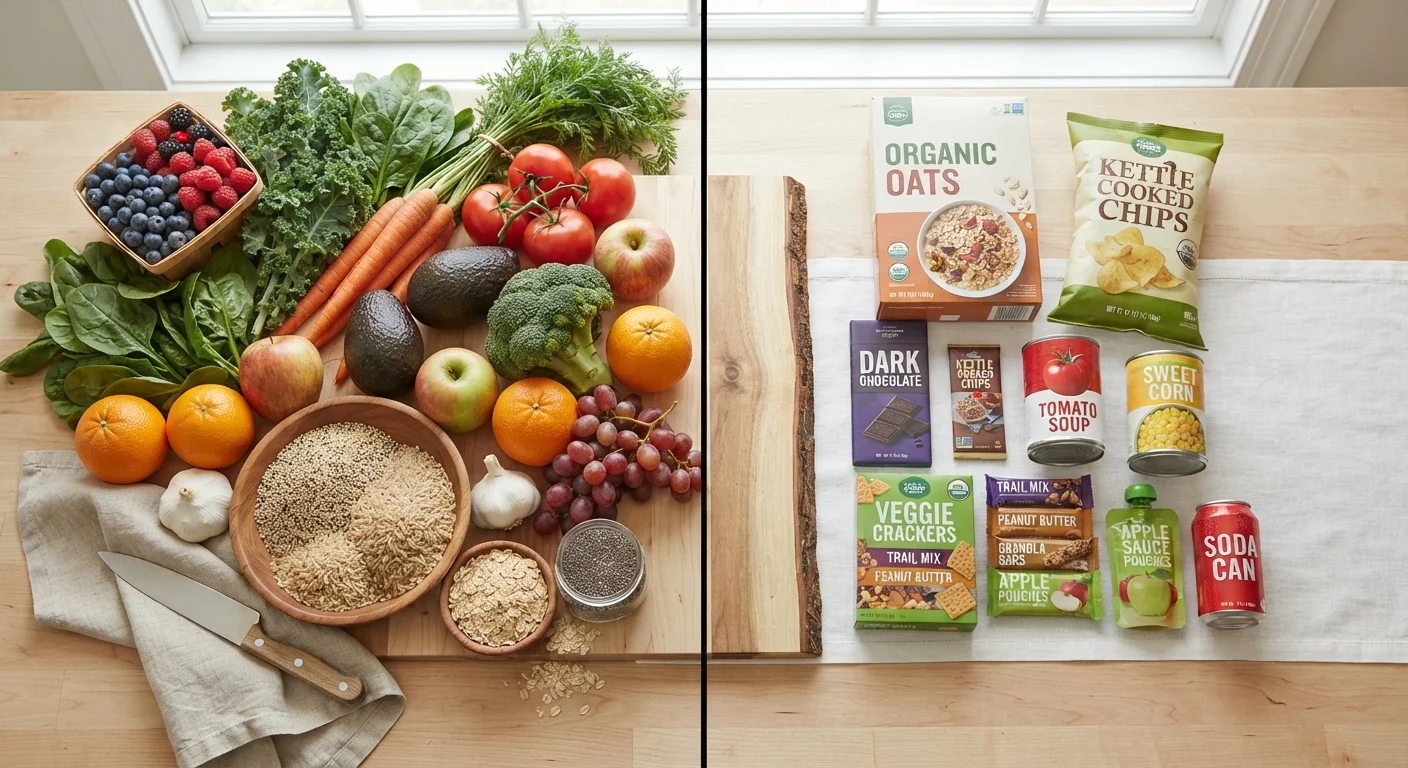
What Do These Terms Actually Mean?
The phrase "whole foods" refers to foods that are eaten in their natural or near-natural state — think an apple, a handful of oats, a piece of fish, or a cup of lentils. They undergo little to no alteration between harvest and your plate. "Processed foods," by contrast, describes any food that has been changed from its natural state through methods like cooking, canning, freezing, fermenting, or adding ingredients.
The critical nuance: processing is not a single category. The NOVA classification system, developed by nutrition researchers at the University of São Paulo, groups foods into four categories ranging from unprocessed and minimally processed foods (fresh produce, plain meats) to ultra-processed products — industrially formulated items containing ingredients rarely found in a home kitchen, such as emulsifiers, artificial flavors, and hydrogenated oils.
Understanding where a food sits on this spectrum matters far more than using "processed" as a blanket negative label. Frozen spinach is processed. So is a cheese puff. They are not equivalent.
The NOVA Classification: A Useful Lens
NOVA categorizes foods by the extent and purpose of processing rather than by nutrient content alone. Group 1 includes unprocessed or minimally processed foods; Group 4 covers ultra-processed formulations. This framework helps explain why plain canned chickpeas (Group 2) and a heavily flavored snack chip (Group 4) shouldn't be evaluated the same way, even though both have been through some form of processing. NOVA is widely used in nutrition research, though it is one of several analytical tools available.
How Do They Compare Nutritionally?
Whole foods tend to deliver nutrients in their most intact form. Fiber, which supports digestive health and helps regulate blood glucose, is often diminished during heavy processing. Refined grains, for instance, lose the bran and germ layers that carry the majority of their fiber and B vitamins. Similarly, many ultra-processed products add sugar, sodium, and saturated fat to improve palatability, shifting their nutritional profile substantially.
| Criterion | Whole Foods | Ultra-Processed Foods |
|---|---|---|
| Fiber content | Generally high and intact | Often low or absent |
| Added sugar | Naturally occurring only | Frequently added in significant amounts |
| Sodium levels | Naturally low | Often high due to preservation or flavor |
| Additives & preservatives | None | Common; may include emulsifiers, colorings |
| Preparation time | Variable; often longer | Minimal; ready to eat or quick to prepare |
| Shelf life | Shorter; requires fresh sourcing | Long; shelf-stable by design |
| Cost | Variable; fresh produce can be costly | Often lower per serving |
That said, some processing genuinely improves nutrition or safety. Pasteurization eliminates harmful pathogens in milk. Fortification adds iron and folic acid to flour, supporting public health outcomes. Canned tomatoes — technically processed — are an excellent source of lycopene, a beneficial antioxidant. The goal isn't to avoid all processing but to be aware of what processing has added or removed.
To sharpen your label-reading skills before your next shopping trip, see our guide to reading a nutrition label without getting confused.
57%
Share of US calories from ultra-processed foods
Research published in BMJ Open estimated that ultra-processed foods account for roughly 57% of total caloric intake among US adults.
4x
More fiber in whole grains vs. refined grains
Whole grains can contain up to four times more dietary fiber than their refined counterparts, according to nutrition composition data from the USDA.
~10%
Higher all-cause mortality risk linked to ultra-processed intake
A large cohort study published in JAMA Internal Medicine found that higher ultra-processed food consumption was associated with elevated all-cause mortality risk.
Practical Ways to Shift the Balance
You don't need to overhaul your kitchen overnight. Small, consistent shifts toward whole and minimally processed foods tend to be more sustainable than dramatic dietary resets. Here are evidence-grounded starting points:
- Anchor meals around minimally processed staples — vegetables, legumes, whole grains, eggs, and plain proteins — and treat heavily processed items as occasional additions rather than defaults.
- Use the ingredient list as a guide: a shorter list with recognizable ingredients generally indicates less processing. Long lists featuring chemical-sounding additives signal ultra-processed territory.
- Embrace convenient whole-food options: frozen vegetables, canned beans rinsed of excess sodium, and plain Greek yogurt are practical and nutritious. Convenience doesn't always mean ultra-processed.
- Cook from scratch when feasible — even simple meals like a stir-fry with frozen vegetables and whole-grain rice put you firmly in minimally processed territory.
For a broader framework on structuring balanced meals, our article on building a nutritionally balanced plate offers a beginner-friendly place to start. And if cost is a consideration, the hidden cost of convenience foods breaks down where convenience spending is worth it and where it isn't.
This article is for general informational and educational purposes only and does not constitute medical or nutritional advice. Consult a qualified healthcare or nutrition professional for guidance tailored to your individual health needs.