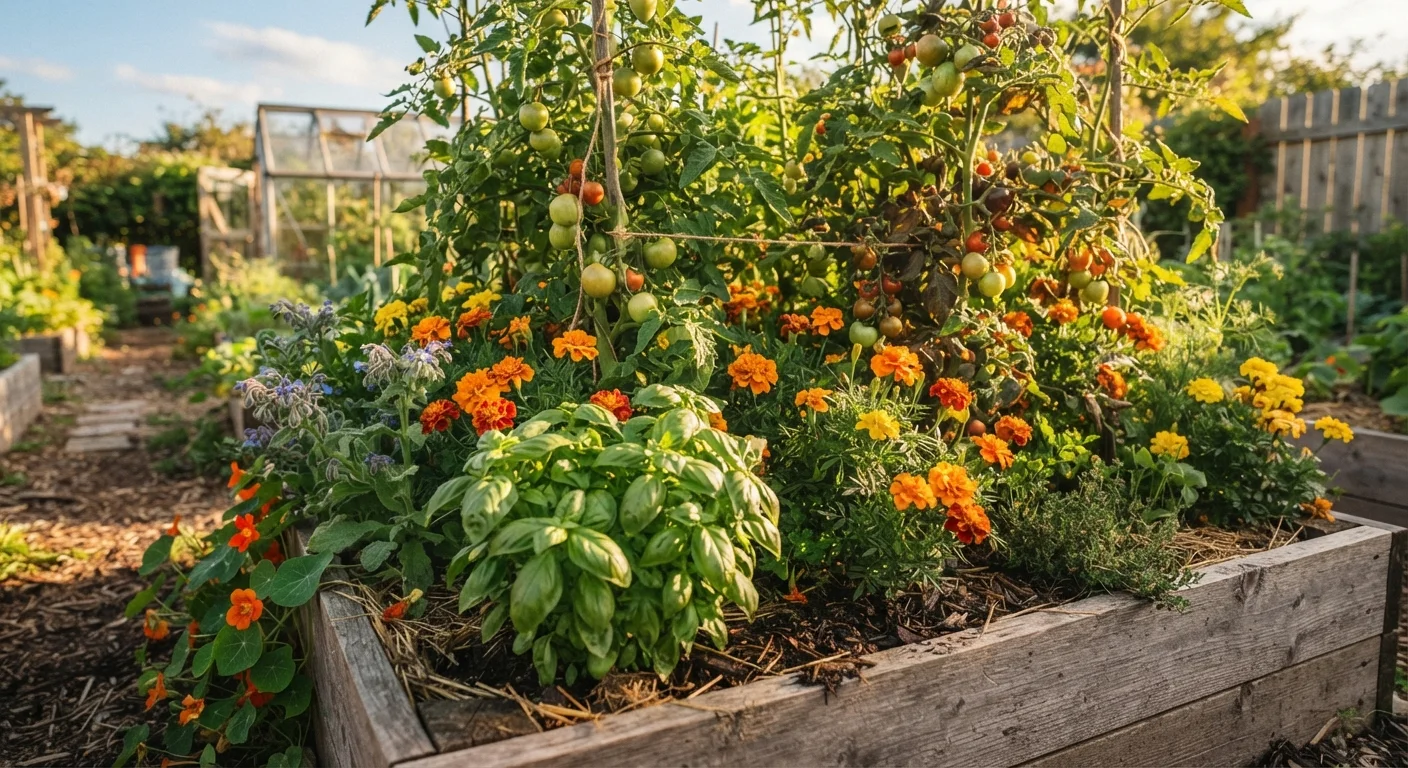
Why Companion Planting Gets Complicated
Companion planting — the practice of growing certain plants in close proximity to benefit one or both — sits in a curious middle ground between traditional knowledge and modern horticulture. Some pairings have genuine scientific support. Many others are passed down as gospel with little more than anecdote behind them.
The challenge for everyday gardeners is sorting the useful from the unreliable. Gardening guides and seed packets repeat the same combinations so frequently that they start to sound like established fact. This article examines the most common claims and explains what the evidence actually shows — so you can make intentional choices for your beds rather than planting by legend.
If you're building your beds from scratch, our season-by-season vegetable garden guide gives a strong overall framework to plant these pairings within.
Myth
Planting basil next to tomatoes repels pests and improves tomato flavour.
Fact
Basil may attract beneficial insects and has some evidence for repelling thrips, but there is no reliable scientific support for it improving tomato flavour.
The flavour claim is the most persistent piece of companion planting folklore. Flavour in tomatoes is shaped by genetics, soil nutrition, watering practices, and ripeness — not by the volatile oils released by a neighbouring basil plant. What basil can do is flower and attract predatory and parasitic insects that help manage pest populations nearby. That's a real, modest benefit — just not the one most gardeners cite.
Myth
Marigolds planted anywhere in the garden will repel all pests.
Fact
French marigolds (Tagetes patula) have demonstrated effectiveness against specific soil nematodes, but only under the right conditions and planting density.
Not all marigolds work equally, and not against all pests. Research has shown that French marigolds planted densely — and left in the ground rather than just bordering a bed — can reduce root-knot nematode populations over a full growing season. Against above-ground insects like aphids or caterpillars, results are far more mixed. Marigolds remain a useful tool, but they work best as part of a broader pest management approach rather than a blanket deterrent.
Myth
The Three Sisters (corn, beans, and squash) is a folk tradition with no real gardening basis.
Fact
The Three Sisters is one of the most functionally sound companion planting systems, with each plant providing a genuine structural or nutritional role.
Developed by Indigenous peoples of North America over centuries, this combination works on several practical levels. Corn provides a vertical trellis for climbing beans. Beans fix atmospheric nitrogen into the soil through root bacteria, benefiting the nitrogen-hungry corn and squash. Squash spreads along the ground, shading out weeds and reducing moisture evaporation from the soil. These are measurable, physical interactions — not symbolic ones. The system is a strong model for how thoughtful spacing and plant diversity can reduce inputs.
Myth
Plants that grow well together in recipes always grow well together in the garden.
Fact
Culinary affinity and horticultural compatibility are completely unrelated — some classic culinary pairings are poor garden neighbours.
Garlic and onions are a common example: they share a harvest plate but compete heavily for similar soil nutrients and moisture. Fennel is another mismatch — it's a kitchen staple but famously inhibits the growth of many common vegetables including tomatoes, peppers, and beans, and is generally best grown in isolation. Making garden planting decisions based on what tastes good together leads to a muddle of nutrient competition and potential allelopathic suppression.
Myth
Deep-rooted plants always compete with shallow-rooted neighbours.
Fact
Pairing plants with different root depths is actually a strategy for reducing competition, not increasing it.
When a deep taproot vegetable like carrots or parsnips grows alongside a shallow-rooted lettuce, they draw water and nutrients from different soil horizons. This vertical differentiation means both plants can access resources without directly competing. It's one of the more practically grounded concepts in companion planting, and it connects directly to understanding what's happening beneath the surface. If you want to dig deeper into how soil layers affect plant health, our guide to soil types covers this well.
Putting Evidence-Backed Pairings to Work
Applying companion planting effectively means leaning on combinations with a plausible mechanism — physical structure, root differentiation, nitrogen fixation, or demonstrated pest effects — rather than taste-based or folklore associations.
Allelopathic Plants Can Suppress Neighbours
Some plants release chemicals that inhibit the growth of nearby species — a property called allelopathy. Black walnut trees are a well-documented example, suppressing many vegetables and ornamentals within their root zone. Before adding a new plant to an existing bed, check whether it has known allelopathic effects on your current plantings.
A few principles to guide your planning:
- Stack functions: Choose pairings where each plant contributes something distinct — shade, ground cover, nitrogen, or pollinator attraction.
- Give plants room: Even beneficial neighbours can cause problems if overcrowded. Poor airflow increases disease pressure regardless of pairing benefits.
- Test and observe: Keep informal notes on what works in your specific conditions. Local soil, humidity, and pest populations matter as much as any general guideline.
Companion Planting Is a Tool, Not a Guarantee
Even well-researched plant pairings work within a larger system. Soil quality, pest pressure, watering habits, and local climate all influence outcomes. Treat companion planting as one helpful layer of your garden strategy — not a standalone solution. For a stronger foundation, start with understanding your soil.
Supporting your companion planting with strong soil health and appropriate mulching gives every pairing the best chance of delivering results. Our guide to mulching covers how to use mulch to protect beds and lock in moisture between plants.
~80%
Companion planting claims lacking controlled evidence
A review of companion planting literature found the majority of traditional pairing recommendations lack replicated, peer-reviewed experimental support.
3–4 weeks
Minimum French marigold soil treatment time
Studies suggest French marigolds need at least a full growing season planted densely to meaningfully reduce nematode populations in garden soil.