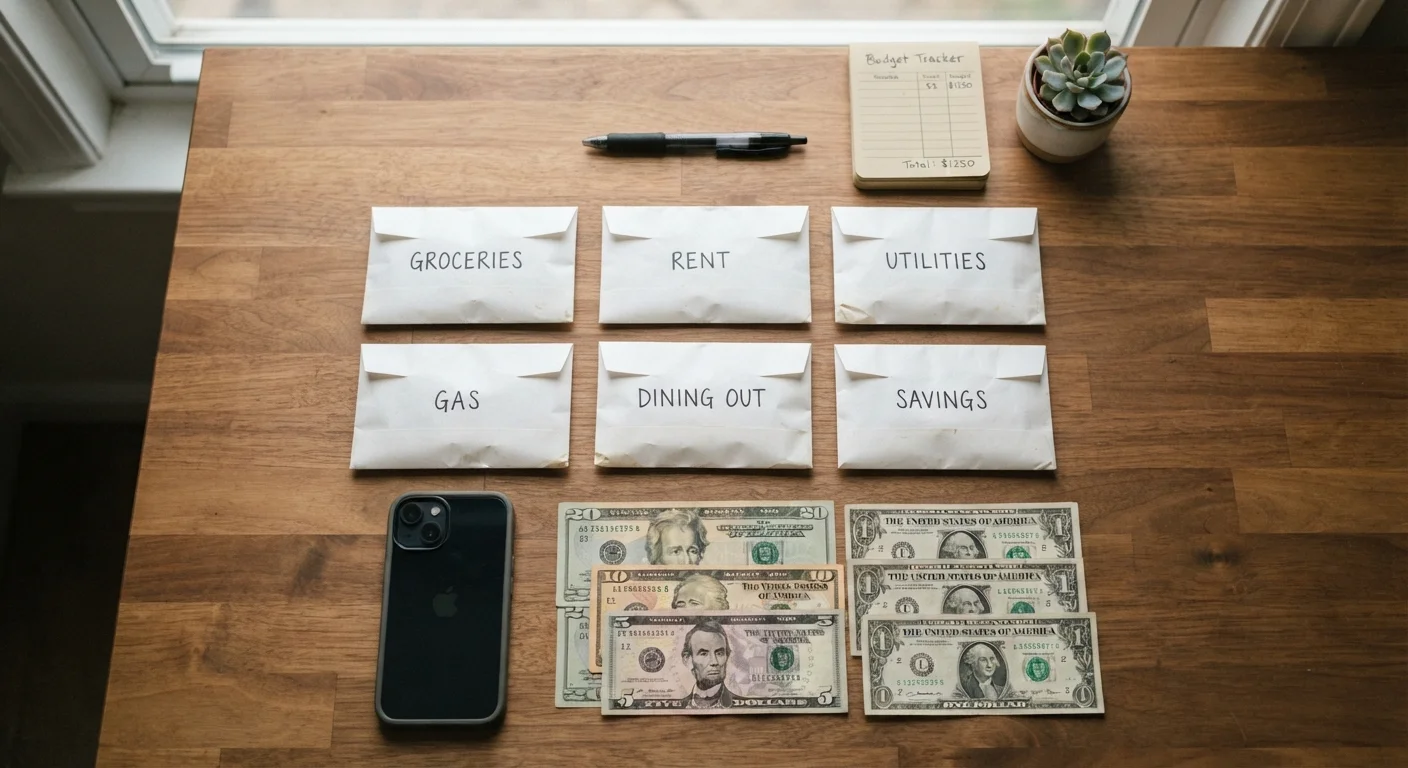
What Is Envelope Budgeting?
Envelope budgeting is a cash-allocation method where you divide your take-home pay into spending categories — groceries, dining out, gas, entertainment — and place the corresponding amount of cash into a labeled envelope for each. When an envelope is empty, spending in that category stops until the next budget cycle. No borrowing from next month, no exceptions.
The system predates the digital era by decades, but it remains widely discussed because its logic is sound: money you can see and touch feels more real than a number on a screen. For people who find it easy to swipe a card without thinking, the physical limit an envelope imposes can be genuinely powerful.
If you haven't built out your broader spending plan yet, our step-by-step guide to building your first monthly budget is a useful starting point before layering in the envelope method.
The Advantages of Cash Stuffing
The envelope method's enduring appeal comes down to a few core strengths that even sophisticated digital tools struggle to replicate fully.
Creates a hard spending limit per category
When physical cash runs out, there's no mechanism to keep spending — unlike a debit card with a remaining balance. This friction is particularly effective for discretionary categories where overspending is habitual.
Makes spending feel tangible and real
Research in consumer behavior consistently suggests that paying with cash increases spending awareness compared to card transactions. Physically handing over bills reinforces the cost of each purchase in a way that tapping a card does not.
Simple to understand and start immediately
No software, subscription, or technical skill is required. A pen, paper, and your pay stub are enough to get started, lowering the barrier to entry for people who've struggled with complex budgeting tools.
Reduces financial decision fatigue
Pre-allocating money at the start of the month eliminates repeated in-the-moment decisions about whether spending is okay. The envelope either has money in it or it doesn't.
Highly visual — progress is immediately obvious
Seeing an envelope thin out mid-month provides an intuitive, at-a-glance signal that spending is accelerating, without requiring any app check-ins or spreadsheet reviews.
~83%
US adults who primarily use non-cash payments
According to Pew Research Center survey data, the vast majority of American adults now go through a typical week without using cash at all, highlighting the friction the physical envelope method faces.
Up to 2x
Spending increase when paying by card vs. cash
Multiple studies in consumer behavior, including work published in the Journal of Consumer Research, have found that payment method influences spending amounts, with cash users tending to spend less per transaction.
The method also pairs well with a monthly budget health check — seeing envelopes run low mid-month is an early warning that spending drift is happening in real time, not after the fact.
The Disadvantages Worth Knowing
Cash stuffing has real limitations that can make it impractical or counterproductive depending on your lifestyle.
Awkward for online and card-based spending
A growing share of everyday purchases — subscriptions, online shopping, digital services — cannot be paid in cash. Applying the envelope logic to these categories requires extra manual tracking steps that undercut simplicity.
Carrying cash creates security and convenience risks
Lost or stolen cash is typically unrecoverable, unlike card transactions that may carry fraud protection. Withdrawing and carrying specific denominations each month also adds logistical overhead.
Misses out on card rewards and purchase protections
Paying in cash foregoes credit card rewards, cashback, and consumer protections on purchases. Over a year, this opportunity cost can be meaningful for households that would otherwise spend the same amount responsibly on a rewards card.
Requires frequent ATM trips and exact change planning
Maintaining the system means regular cash withdrawals and keeping track of correct denominations per envelope — a time cost that adds up and can lead people to abandon the method after the initial enthusiasm fades.
Difficult to manage shared or household budgets
When multiple people spend from the same envelope, coordination becomes complicated. Splitting a single physical envelope between two partners or tracking who spent what from shared cash requires ongoing communication that digital tools handle more cleanly.
It's also worth recognising that envelope budgeting is one framework among several. If the all-or-nothing feel of physical cash doesn't suit you, compare it against structured alternatives — our breakdown of zero-based budgeting vs. the 50/30/20 rule walks through two popular approaches side by side.
Does It Translate to the Digital World?
Several budgeting apps now offer virtual envelope systems that mimic the original method without requiring physical cash. You allocate dollar amounts to digital "envelopes" or spending pots, and the app deducts from the relevant category each time you log a transaction.
Popular Apps That Replicate Envelope Logic
Several budgeting applications are built around the envelope or "spending pots" concept, allowing users to pre-allocate income digitally and track drawdowns in real time. While this article doesn't endorse specific products, a web search for "digital envelope budgeting apps" will surface widely reviewed options. Look for features like manual transaction entry, category rollover controls, and shared-access for households. Free tiers with core functionality are commonly available.
The trade-off: virtual envelopes require manual transaction logging to be effective, which introduces a discipline requirement of its own. Automatic bank-feed imports help, but category mismatches and uncategorized purchases can quietly erode accuracy. The system only works if you check it regularly — ideally after every purchase or at least daily.
For those whose everyday expenses are primarily card-based, a digital envelope approach is likely more practical than physical cash while preserving the category-limit logic that makes the method useful.
How to Decide If It's Right for You
Envelope budgeting tends to work best when it's applied selectively rather than across your entire financial life. Most people find it most effective for two or three problem spending categories — typically groceries, dining, or entertainment — while handling fixed expenses like rent, utilities, and subscriptions through standard bank transfers.
Ask yourself: Are there one or two spending areas where you consistently overshoot? Do abstract account balances make it easy to rationalize extra spending? If yes, the envelope structure adds a concrete boundary that's hard to talk yourself around.
If you already track spending carefully and review it regularly, the added step of physical cash or manual app logging may offer diminishing returns. In that case, common budgeting myths — like the belief that you need a rigid system to stay on track — may be doing more to hold you back than your actual method. And don't overlook how small daily spending habits interact with any budgeting method you choose; micro-transactions can undermine even a well-stuffed envelope if they go untracked.
This article is for general informational purposes only and does not constitute personalized financial advice. Consider speaking with a qualified financial professional about strategies suited to your individual situation.