Why Mental Stimulation Matters More for Solo Cats
Cats are often described as independent, but that characterization can be misleading — especially for cats living alone. Without a feline companion to chase, wrestle, or groom, a single cat depends almost entirely on its environment and on you to meet its cognitive and behavioral needs. When those needs go unmet, boredom and chronic low-level stress can follow.
Understimulation in cats can show up as overgrooming, destructive scratching, attention-seeking behavior, or lethargy that's easy to dismiss as personality. If you've noticed any of these, enrichment is often the most effective first step. For a broader look at stress cues you might be overlooking, see our guide to subtle signs of stress in pets.
The good news: you don't need an elaborate setup or endless free time. The strategies below are practical, low-cost, and grounded in how cats actually think and behave.
Start with observation, not purchases
Before investing in new enrichment products, spend a few days noting when your cat is most active, where it tends to rest, and what it already gravitates toward. A cat that loves stalking crinkle balls needs different enrichment than one that's motivated by food. Matching the approach to your individual cat's drives makes every strategy more effective.
7 Ways to Keep a Solo Cat Mentally Engaged
Rotate toys on a weekly schedule
Cats habituate quickly to the same objects — a toy that was fascinating on Monday may be completely ignored by Thursday. Rather than buying more toys, try rotating what's available. Keep two or three items out at a time and swap them with stored items weekly. When a toy reappears after a week's absence, it often registers as novel again and sparks renewed interest. This works particularly well with crinkle balls, toy mice, and feather wands.
A toy that disappears for a week often feels brand new when it returns.
Use puzzle feeders and food-dispensing toys
A cat's ancestral feeding pattern involves hunting — stalking, pouncing, and working for a meal. Serving food only in a bowl eliminates all of that cognitive effort. Puzzle feeders and food-dispensing toys restore some of that challenge by requiring your cat to manipulate an object to access kibble or treats. Even a simple homemade version — kibble scattered across a muffin tin covered with tennis balls — provides meaningful mental work. These are especially valuable during the hours you're away from home.
Puzzle feeders replace the mental effort a cat would spend hunting in the wild.
Create vertical territory with cat trees and shelves
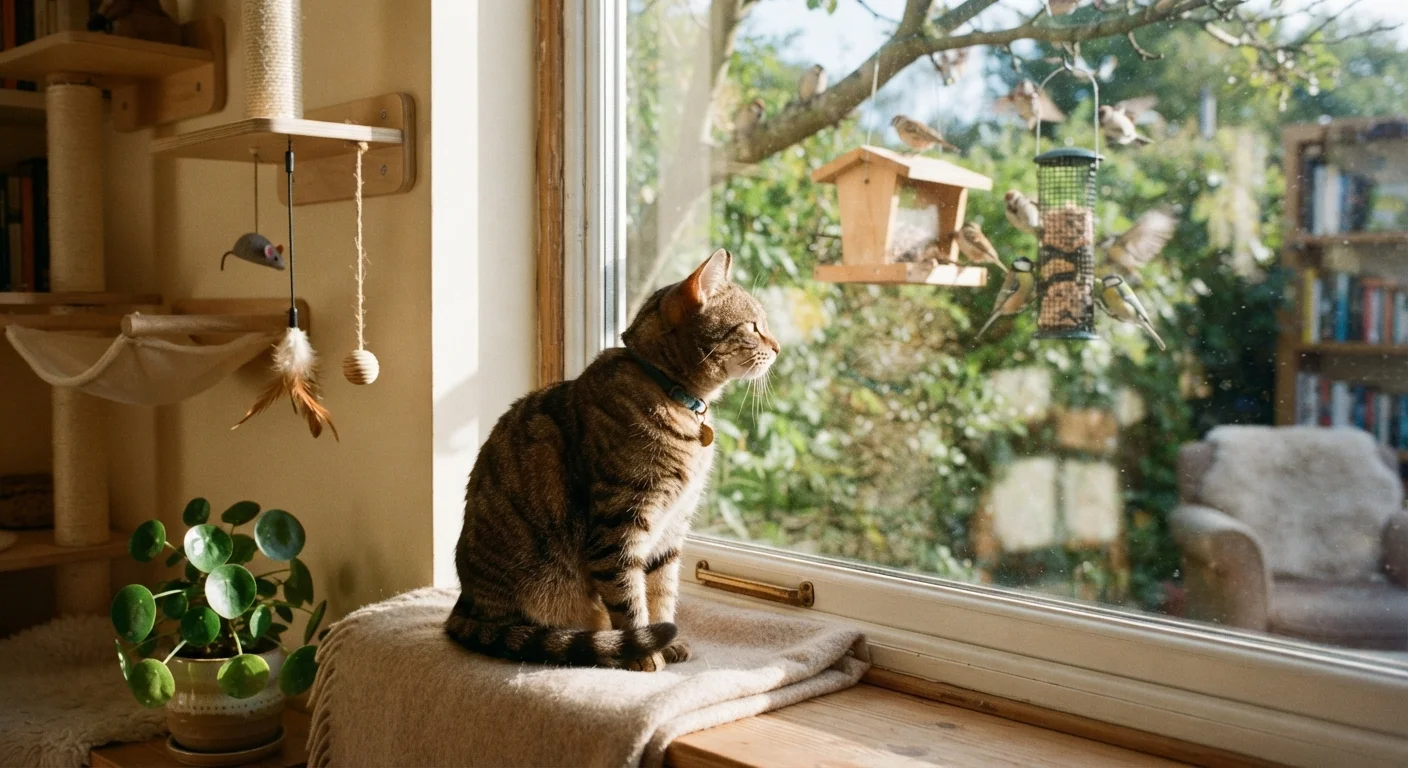
Cats are natural climbers and feel more secure when they can survey their environment from height. A cat that only has floor-level access to a room effectively has much less usable territory than one that can climb a cat tree or wall-mounted shelves. Vertical space also allows a cat to move away from perceived threats — loud noises, unfamiliar visitors — without fleeing entirely. Multiple levels with different textures (sisal, carpet, bare wood) add sensory variety. Even a single tall cat tree near a window can substantially expand a cat's perceived territory. For more on how indoor environments affect wellbeing, see our look at indoor versus outdoor cat life.
Vertical space multiplies your cat's usable territory without expanding the room.
Position a window perch with an outdoor view
Window watching functions as passive enrichment — your cat processes movement, sound, and scent cues from outside without any effort on your part. A stable perch at window height is the bare minimum. To amplify the experience, consider placing bird feeders or a small water feature within the sightline. Even squirrels or passing foot traffic provide enough unpredictable movement to hold a cat's attention for meaningful stretches of the day. Keep the window clean for maximum visibility.
A well-positioned window perch provides hours of low-effort passive stimulation.
Schedule short daily interactive play sessions
Interactive play — using a wand toy, laser pointer, or tossed ball — is the one enrichment activity that also strengthens your bond with your cat. Research on feline play behavior suggests that two to three sessions of 10–15 minutes per day is more effective than a single long session, because it more closely mirrors natural hunt-rest-hunt patterns. Always end play sessions with a 'catch' — let your cat successfully grab the toy — to avoid frustration. Consistency matters more than duration here.
Two short play sessions daily outperform a single long one for most cats.
Introduce safe scent and sensory enrichment
Cats experience the world largely through scent, and their indoor environments are often olfactorily monotonous. Introducing new scents — dried herbs like valerian or silver vine, pinecones brought in from outside, or a paper bag that has held groceries — gives your cat something novel to investigate thoroughly. Catnip is well known, but about 30–50% of cats don't respond to it at all due to genetics; silver vine tends to elicit a response in a broader range of cats. Always supervise first introductions and remove anything that shows signs of ingestion risk.
Cats process the world through scent — new smells are genuine mental stimulation.
Try cat-specific audio and visual media
Purpose-made videos and audio tracks featuring birds, squirrels, or fish have been used in shelter enrichment programs to reduce stress behaviors in confined cats. Results for home cats are mixed — some individuals engage intensely, others ignore screens entirely. It's worth a low-stakes trial: play a video near a comfortable perch and observe whether your cat watches, hunts at the screen, or simply walks away. If it holds interest, it's a legitimate option for periods when you're out. Avoid leaving loud or high-pitched audio running all day, as this can itself become a stressor.
Cat-specific videos work well for some cats — observe your individual cat's response before committing.
When enrichment isn't enough
Some cats that appear chronically bored or anxious may have underlying medical or behavioral conditions that enrichment alone won't resolve. If your cat's behavior changes suddenly, if it's overgrooming to the point of skin irritation, or if it seems consistently distressed despite a stimulating environment, a veterinary check-up is the appropriate next step. A certified cat behavior consultant can also help with more complex cases.
Building a Routine That Sustains Engagement
Enrichment works best when it's woven into a predictable daily rhythm rather than offered sporadically. Cats are creatures of habit — a consistent schedule for play, feeding, and exploration helps reduce baseline anxiety and makes each enrichment session more impactful. If you're still in the early stages of setting up your cat's life at home, our guide for first-time cat owners covers environment setup in detail.
Pairing enrichment with your existing routine — a puzzle feeder at breakfast, a 10-minute wand session before bed — means it actually happens. Small, consistent investments in your cat's mental life pay dividends in calmer behavior and a stronger bond over time.
This article is for general informational purposes and is not a substitute for personalized veterinary advice. If your cat shows sudden behavioral changes, consult a veterinarian or certified animal behaviorist.