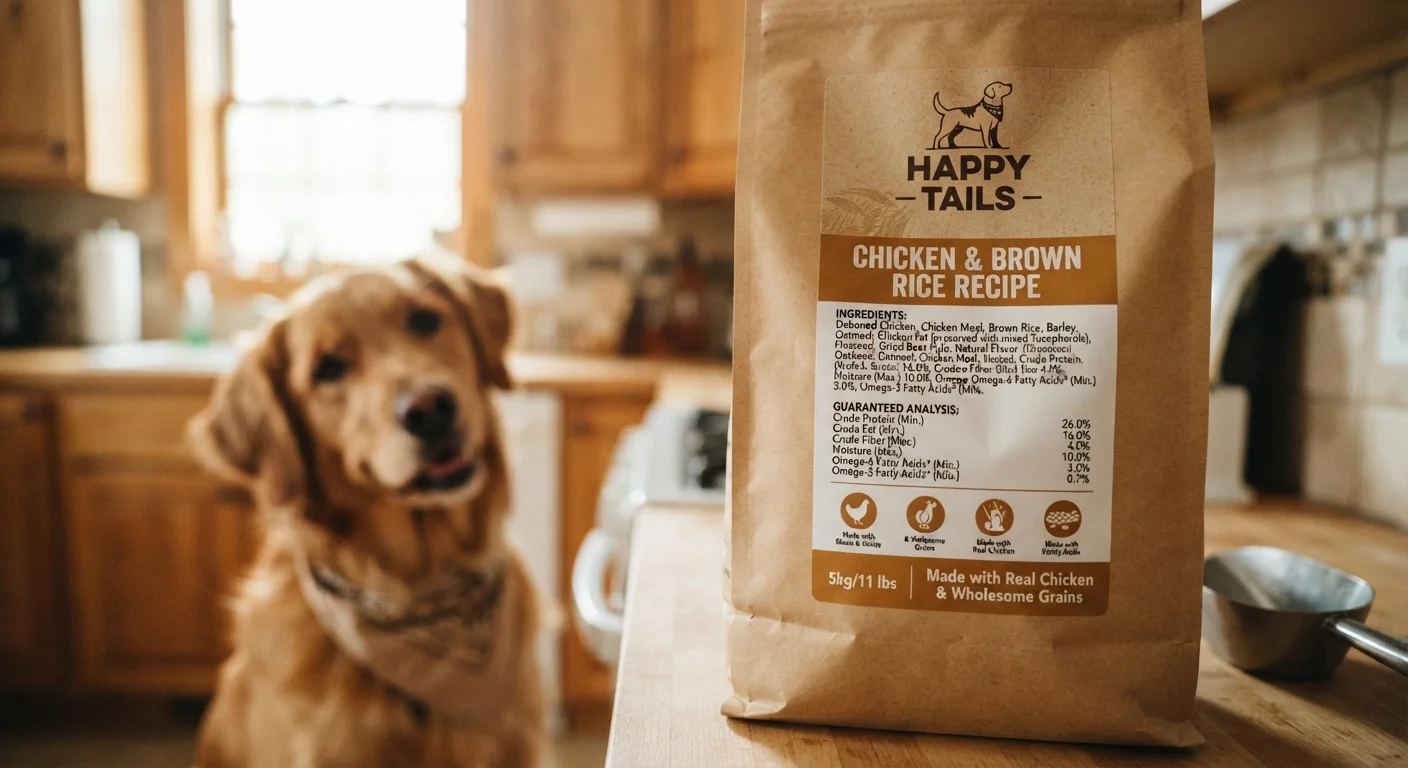
Why the Ingredients List Isn't Straightforward
Dog food packaging is governed by regulations set by the AAFCO — a body that establishes ingredient definitions and labeling standards adopted by most U.S. states. While these rules create a baseline of consistency, they also leave plenty of room for marketing language that can mislead well-intentioned owners.
Ingredients must be listed by weight before processing, which sounds helpful but creates a common distortion: raw meat contains significant water weight, so it can appear near the top of the list even when it contributes less protein than a dry ingredient listed further down. This is sometimes called ingredient splitting in reverse — and it's one reason you shouldn't judge a food on its first ingredient alone.
For a broader look at how ingredient lists work on food packaging generally, see how to read a nutrition label without getting confused.
| Ingredient listing rule | Listed by pre-processing weight, heaviest first (AAFCO model regulations) |
| Minimum for "[Protein] Dog Food" label | 95% of total weight (excluding added water) (AAFCO naming guidelines) |
| Minimum for "[Protein] Dinner/Entrée" label | 25% of total formula weight (AAFCO naming guidelines) |
| Minimum for "With [Protein]" label | 3% of total formula weight (AAFCO naming guidelines) |
| Regulatory definition of "Holistic" | None — no AAFCO standard exists (AAFCO definitions) |
| Life stages covered by labels | Growth, adult maintenance, all life stages, or senior (not regulated by AAFCO) (AAFCO model regulations) |
Key Label Sections and What They Actually Tell You
The Nutritional Adequacy Statement
Often overlooked, this is arguably the most important part of the label. Phrases like "complete and balanced for adult maintenance" or "for all life stages" indicate the food meets AAFCO nutrient profiles. If a label reads "intended for intermittent or supplemental feeding only," that food cannot serve as a dog's sole diet.
The Guaranteed Analysis
This panel lists minimum percentages of crude protein and fat, and maximum percentages of moisture and fiber. Critically, it does not tell you the source or quality of those nutrients — just that they're present at those levels. Comparing guaranteed analysis figures across wet and dry foods is also unreliable without converting both to a dry matter basis, since moisture content varies enormously between formats. The differences between dry kibble and wet food article explains this comparison in more detail.
Ingredient Definitions Worth Knowing
AAFCO assigns specific definitions to terms like meal, by-product, and digest. Chicken meal, for example, is rendered, dried chicken that's actually more protein-dense than fresh chicken listed by weight. Poultry by-products include organ meats and are nutritionally valuable, but quality varies by manufacturer. Meat and bone meal without a named species (e.g., "chicken" or "beef") is a less specific ingredient that warrants more scrutiny.
AAFCO
The Association of American Feed Control Officials. A non-governmental body that establishes model regulations for pet food ingredients, labeling, and nutrient profiles adopted by most U.S. states.
Guaranteed Analysis
A panel on pet food labels listing minimum crude protein and fat percentages and maximum moisture and fiber percentages. It indicates nutrient levels but not nutrient quality or source.
Dry Matter Basis
A method of comparing pet food nutrient levels after mathematically removing moisture content, enabling fair comparison between wet and dry foods.
Nutritional Adequacy Statement
A required label statement confirming whether a food meets AAFCO nutrient profiles for a specific life stage, or is intended only for supplemental feeding.
Meal (as in chicken meal)
A rendered, dried ingredient in which water and fat have been removed. Meat meals are more protein-dense by weight than fresh meat listed by the same name.
By-Products
Secondary animal parts such as organ meats, not including hair, horns, or teeth. By-products are defined and regulated by AAFCO and can be nutritionally valuable.
Common Label Claims and Their Limits
Certain front-of-bag claims follow AAFCO naming rules that dictate actual ingredient content:
- "Chicken Dog Food" — chicken must make up at least 95% of the total weight (excluding water).
- "Chicken Dinner" / "Chicken Entrée" — the named ingredient needs to be only 25% or more.
- "With Chicken" — just 3% chicken is required.
- "Chicken Flavor" — no minimum quantity; the food only needs to be detectable by a dog.
Terms like natural, holistic, and human-grade are either loosely defined or carry no AAFCO-enforced standard. Natural has a defined meaning (no synthetic ingredients), but holistic has no regulatory definition at all.
"Natural" Has a Definition — Others Don't
AAFCO defines "natural" to mean a food free from artificial flavors, colors, or synthetic preservatives added directly. However, terms like "holistic," "premium," and "human-grade" have no enforceable regulatory definitions in U.S. pet food law. These terms are marketing descriptors, not nutritional guarantees.
If your dog has food sensitivities or a health condition that makes diet particularly important, consult your veterinarian before changing foods — they can help interpret labels in the context of your dog's specific needs. You may also want to review foods that can make dogs seriously ill to understand which ingredients to avoid entirely.
95%
Meat content required for a single-protein label claim
Under AAFCO naming rules, a food called simply "Chicken Dog Food" must contain at least 95% chicken by dry weight.
3%
Minimum meat content for a "With [Protein]" claim
AAFCO permits the "with" designation with as little as 3% of the named ingredient, a significant difference from primary protein labeling.