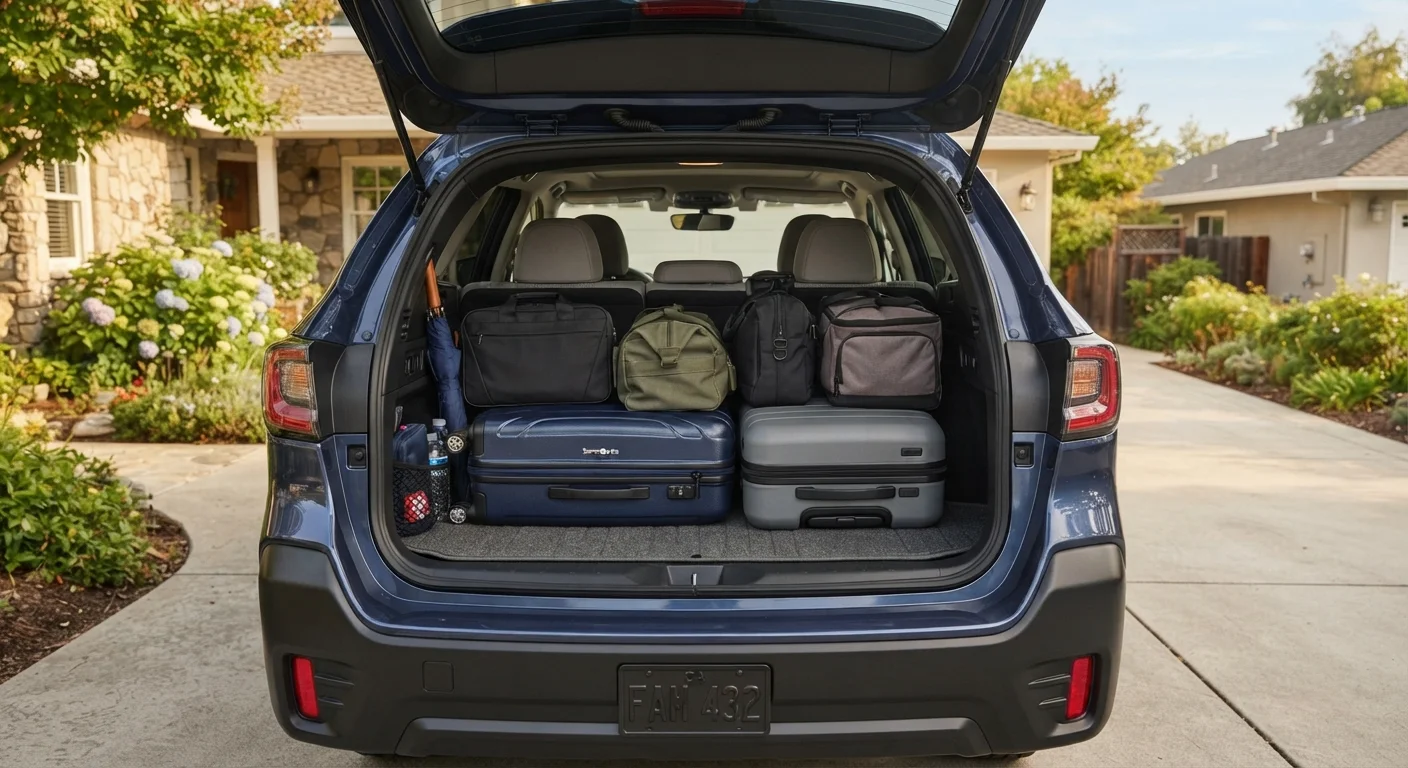
Why Packing Strategy Is a Safety Issue, Not Just a Comfort One
Most drivers think about packing as a puzzle — fitting the most stuff into available space. In reality, how you load a vehicle has measurable effects on braking distance, steering response, and stability, particularly at highway speeds. A car loaded carelessly handles differently than one packed with weight distribution in mind, and in an emergency maneuver, that difference matters.
Before you consider what to bring, it helps to run through your vehicle's mechanical readiness first. See the pre-departure vehicle check for a systematic look at tires, fluids, and other essentials before any long drive.
“The way a vehicle is loaded affects its dynamics in ways most drivers never consider — weight shifts that seem minor at low speed become consequential at 70 miles per hour on a crowded interstate.”
— AAA Foundation for Traffic Safety, US road safety research organization
Core Principles for Safe, Efficient Loading
These practices apply whether you're driving a compact sedan, a minivan, or a full-size SUV. The physics are the same — a vehicle's center of gravity and weight distribution respond predictably to where mass is placed.
Load heaviest items lowest and closest to the axles
A lower center of gravity improves cornering stability and reduces the risk of rollover. Placing heavy items over or near the rear axle rather than in the far back of a trunk or cargo area keeps weight distribution more balanced front to rear.
Distribute weight evenly from left to right
Side-to-side imbalance causes a vehicle to pull toward the heavier side, creating driver fatigue and uneven tire wear over a long trip. On curved highway ramps, an offset load also increases lean.
Never block rearward visibility through the mirror
A fully obstructed rearview mirror forces reliance solely on side mirrors, creating a significant blind spot directly behind the vehicle. This is both a safety hazard and, in some states, a traffic violation.
Secure all loose cargo before moving the vehicle
Unsecured items shift under braking and in turns, potentially striking occupants or interfering with pedal access. In a collision, loose cargo becomes a projectile regardless of its weight.
Check tire pressure after loading, not before
Adding several hundred pounds of passengers and luggage affects the optimal tire inflation needed for safe handling and load bearing. Tire sidewalls flex more under load, generating excess heat at sustained highway speeds if underinflated.
Keep emergency and frequently-needed items immediately accessible
Burying a first-aid kit or jumper cables under everything else defeats their purpose. Items needed quickly in an emergency should not require unpacking the vehicle to reach.
Cargo Restraint and Cabin Organization
One of the most underappreciated road trip hazards is unsecured cargo inside the cabin. In a crash or hard stop, loose items — even something as light as a water bottle — can travel at high speed toward occupants. This isn't theoretical; crash test research consistently identifies loose cargo as a significant secondary injury source.
Use the 'Shake Test' Before Closing Up
After packing, give each item in the cargo area a firm push in multiple directions. If it shifts more than a few inches, it needs securing. Soft bags that compress slightly are fine; hard-sided cases, tools, or containers that slide freely are not. This simple test takes 30 seconds and catches the most common restraint oversights.
Use cargo nets, trunk organizers, or purpose-designed straps to anchor items that can't go in the trunk. Reserve the rear seats for soft bags that won't shift dangerously, and keep the floor behind front seats clear. For trips with children, organization becomes doubly important — see what actually makes road trips with kids work for strategies specific to family vehicles.
Quick Wins Before You Leave the Driveway
A few checks take under five minutes but meaningfully reduce risk for the entire journey. Do them every time, not just on major trips.
Once you've loaded the vehicle, also consider your route and conditions. Adverse weather changes how a loaded vehicle performs — stopping distances increase further when cargo is heavy and roads are wet. The guide to planning around weather covers what most drivers overlook when conditions shift.
Payload Limits and What Exceeding Them Actually Means
Every vehicle has a Gross Vehicle Weight Rating (GVWR) — the maximum safe operating weight including passengers, cargo, and fuel. This figure appears on a sticker inside the driver's door jamb. Exceeding it isn't just a legal issue; it stresses suspension components, reduces braking effectiveness, and can overheat tires at sustained highway speeds.
1,500 lbs
Typical cargo capacity of a mid-size SUV
Payload ratings vary widely by vehicle; always verify your specific model's GVWR on the door-jamb placard rather than relying on class averages.
40%
Increase in stopping distance when significantly overloaded
Engineering analyses of vehicle dynamics consistently show that excess cargo weight extends braking distances well beyond what most drivers anticipate at highway speeds.
Roof racks and cargo carriers add usable space but raise the vehicle's center of gravity, increasing rollover susceptibility on curves. If you use a roof carrier, load only lightweight, bulky items up top — sleeping bags and camping chairs rather than tool kits or water jugs. Driving style should also adapt: follow greater distances and enter curves more gradually. For more on following distance and its real-world impact, see the science behind tailgating and following distance.
For a comprehensive checklist of what to bring — beyond luggage — consult the road trip packing list most drivers overlook. It covers safety gear, vehicle essentials, and comfort items often forgotten until mile 200.