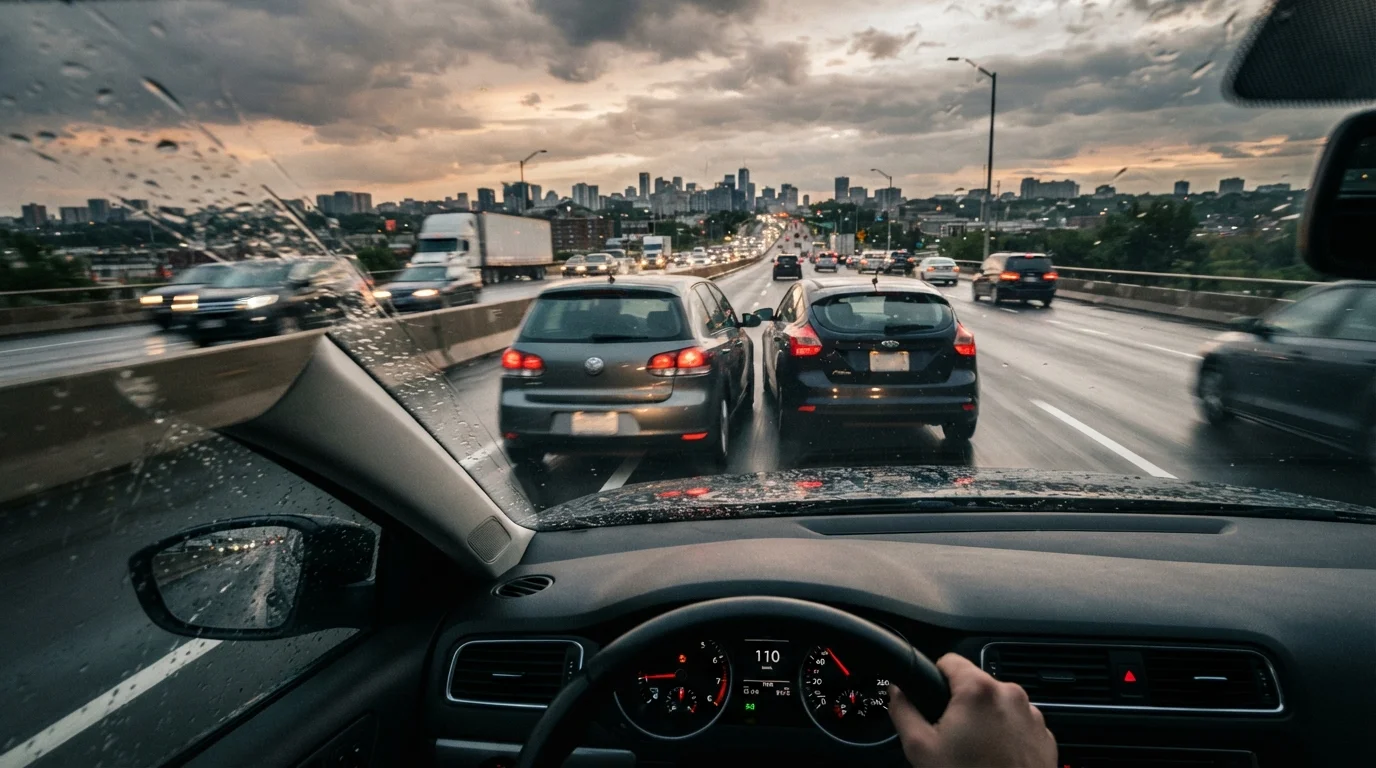
The Physics You Can't Outrun
Driving feels intuitive, but the forces governing a moving vehicle are indifferent to driver confidence. At 60 mph, your car is covering approximately 88 feet every single second. That number alone reframes what a "small" gap between vehicles actually means in practice.
Stopping a vehicle involves two distinct phases: the perception-reaction phase, where the driver processes a hazard and physically initiates braking, and the braking phase, where the vehicle's mechanical systems bring it to a stop. Neither is instantaneous. Research consistently places average perception-reaction time at around 1.5 seconds under alert conditions — translating to roughly 132 feet traveled at 60 mph before the brakes even engage. Add the braking distance itself, and total stopping distance at that speed on a dry road is often cited at around 240–270 feet under typical conditions.
Tailgating compresses or eliminates this physical buffer entirely. When the vehicle ahead stops unexpectedly, there is simply no room for physics to work in the following driver's favor.
88 ft/sec
Distance traveled per second at 60 mph
A standard measure used in traffic safety education to illustrate speed in tangible terms.
1.5 sec
Average perception-reaction time for alert drivers
Widely cited in driver education and traffic engineering literature as a baseline under normal conditions.
50%+
Increase in stopping distance on wet roads
Commonly referenced in road safety research and state driver handbooks when describing wet-weather braking.
~270 ft
Approximate stopping distance at 60 mph (dry road)
Figures vary by vehicle type, tire condition, and braking system; this reflects a broadly cited estimate for passenger cars.
Reaction Time: The Hidden Variable
Most drivers overestimate how quickly they respond to hazards. The 1.5-second average applies to an alert, focused driver in controlled conditions. In reality, cognitive distraction, fatigue, and even routine familiarity with a route can extend that window significantly. Our related article on cognitive load and reaction time explores in detail how mental distraction compounds this effect.
A driver glancing at a navigation screen for just two seconds at 60 mph travels the length of a basketball court before their eyes return to the road — and they haven't even perceived the hazard yet. Combine a distracted or fatigued driver with an insufficient gap to the vehicle ahead, and the crash scenario writes itself. Gradual habits like routinely following closely can desensitize drivers to how dangerous the practice is.
“Drivers consistently underestimate how far their vehicle travels during the time it takes to perceive and respond to a hazard. The gap they think is safe is often a fraction of what physics actually requires.”
— National Highway Traffic Safety Administration, U.S. federal road safety authority, driver education guidance
How Conditions Multiply the Risk
Following distance is not a fixed number — it's a dynamic judgment that must account for conditions at any given moment. Wet pavement can increase stopping distance by 50% or more compared to dry conditions, because tire grip (friction coefficient) drops substantially. Ice can multiply that figure several times over.
Vehicle load matters too. A vehicle carrying heavy cargo has more momentum to overcome, requiring greater braking force and distance. How you load your vehicle directly affects its handling and stopping behavior — something worth factoring into following distance decisions on loaded road trips.
Speed itself has a compounding effect. Stopping distance doesn't increase linearly with speed — it grows faster. A vehicle traveling at 60 mph doesn't take twice as long to stop as one at 30 mph; it takes considerably longer, because braking distance is proportional to the square of speed.
Adjust Your Gap for Every Condition
Think of your following distance as a variable, not a constant. Shift from three to four seconds in light rain, and to five or six in heavy rain, fog, or on roads you're unfamiliar with. If you're hauling weight or driving a larger vehicle, add at least an extra second to your baseline gap as a standard habit.
Applying the Three-Second Rule — and When to Go Further
The three-second rule is a practical, speed-agnostic method for maintaining appropriate following distance. Choose a fixed landmark — a sign, bridge, or painted line. When the vehicle ahead passes it, count "one-thousand-one, one-thousand-two, one-thousand-three." Your vehicle should not reach that point until you've finished counting. If it does, you're too close.
Three seconds represents a reasonable minimum on dry roads under normal alert conditions. Expand to four or more seconds in rain, fog, construction zones, or when carrying extra weight. Driving environments matter as well — the risk calculus on a highway differs meaningfully from urban roads, as explored in our piece on highway versus urban driving risk profiles.
The Three-Second Rule Doesn't Cover Everything
While the three-second rule is widely endorsed as a practical standard, it assumes alert, unimpaired driving on roads with typical surfaces. High-speed freeway driving, adverse weather, and heavy vehicle loads all call for more distance. Treat the rule as a floor, not a ceiling, and adjust upward when any risk factor is present.
It's also worth noting what the three-second rule does not do: it doesn't account for multi-vehicle pileup risk, where a chain of closely following vehicles creates a cascade of collisions when the first vehicle stops. Maintaining your own gap won't protect you from a vehicle behind you that is tailgating — which is why position awareness in traffic is a broader skill than distance management alone.
Ultimately, safe following distance is one of the most straightforward adjustments a driver can make. It costs nothing, requires no equipment, and can make the difference between a near-miss and a serious crash. The physics will not negotiate — but drivers can.