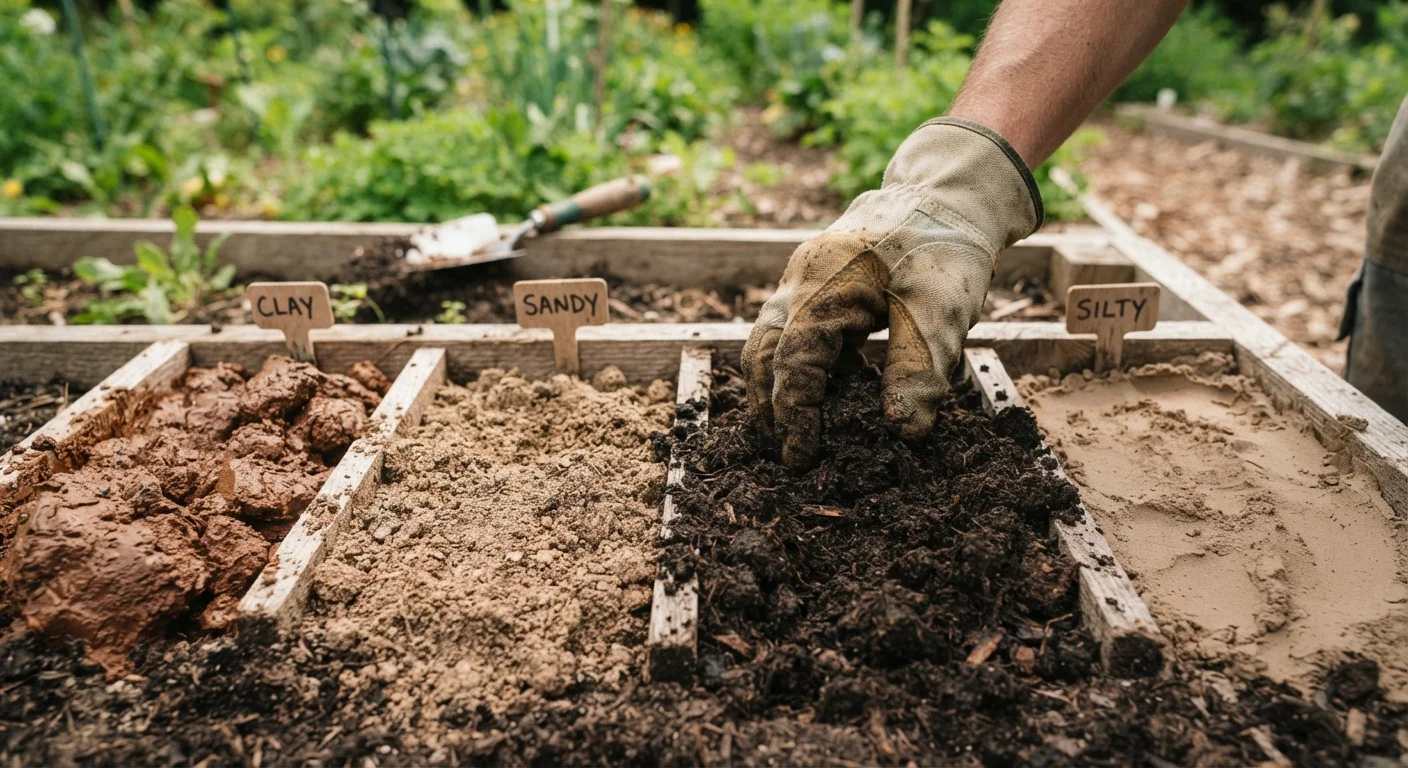
The Four Main Soil Types and What Sets Them Apart
Every garden bed sits on a unique blend of mineral particles, and those particles determine how your soil behaves day to day. The four soil types most gardeners encounter are clay, sandy, silty, and loamy. Understanding each one helps you work with your ground rather than against it.
- Clay soil is made of very fine, tightly packed particles. It holds water and nutrients well but drains slowly, compacts easily, and can become rock-hard when dry.
- Sandy soil has large, loosely arranged particles that drain quickly — sometimes too quickly. Water and nutrients pass through before roots can absorb them, making it challenging for moisture-dependent plants.
- Silty soil sits between clay and sand in particle size. It's fairly fertile and retains moisture reasonably well, but its smooth texture makes it prone to compaction and surface crusting.
- Loamy soil is a balanced mix of sand, silt, and clay. It drains well, holds adequate moisture, and stays loose enough for roots to penetrate — qualities that make it the benchmark most gardeners aim for.
~45%
Mineral content of typical garden soil
According to general soil science principles, healthy soil is roughly 45% minerals, 25% water, 25% air, and 5% organic matter.
2 µm
Maximum diameter of a clay particle
The USDA defines clay particles as less than 0.002 millimeters (2 micrometers) — thousands of times smaller than a grain of sand.
1–3 seasons
Typical time to improve clay soil structure
Consistent addition of compost over multiple growing seasons is generally required before clay soil shows meaningful improvement in drainage and workability.
How to Test Your Soil Type at Home
You don't need a laboratory to identify your soil. Two simple hands-on tests give you reliable results in minutes.
The Ribbon Test
Take a small handful of moist (not soaking wet) soil and squeeze it firmly in your palm. Then push your thumb against it to try to form a ribbon. Clay-heavy soil forms a long, smooth ribbon of 2 inches or more. Loamy soil creates a short ribbon that breaks easily. Sandy soil simply crumbles and won't ribbon at all. Silty soil feels slippery or soapy and forms a modest ribbon with a shiny surface.
The Jar Settlement Test
Fill a clear jar about one-third with soil, top it up with water, shake vigorously, and let it settle for 24–48 hours. The heaviest particles (sand) settle to the bottom first, silt forms the middle layer, and clay sits on top. The proportions of each layer reveal your soil's makeup at a glance.
Test Soil When It's Moist, Not Soaking
For the most accurate ribbon or squeeze test results, collect soil that is evenly moist — similar to a wrung-out sponge. Soil that is too dry won't bind properly, and soil that is waterlogged can mimic the behavior of a heavier texture than it actually is. Testing after a day or two following light rain tends to give the clearest picture.
For an even more complete picture — including pH and nutrient levels — your local cooperative extension service often offers inexpensive soil testing. This is especially useful before starting a new bed or vegetable garden. See our season-by-season vegetable garden framework for guidance on building from the ground up.
Improving Your Soil: Practical Strategies That Work
Once you know what you're working with, targeted amendments can shift your soil closer to the balanced, workable loam that most plants prefer. The universal answer is organic matter — specifically compost.
Organic Matter Helps Every Soil Type
Whether your soil is too dense or too loose, compost is the most broadly effective amendment available. It loosens clay, binds sandy particles, and adds nutrients across all soil types. There is no universally correct amount — start with a 2–3 inch layer worked into the top foot of soil and adjust based on how your soil responds over subsequent seasons.
For clay soil: Work aged compost into the top 8–12 inches of your beds each season. Avoid digging clay when it's wet, which collapses the pore structure. Over time, organic matter opens up the texture and improves drainage.
For sandy soil: Compost and well-rotted manure help sandy soil retain both moisture and nutrients. Mulching heavily between plants slows evaporation at the surface. Our guide to mulching done right covers which materials work best and how to apply them correctly.
For silty soil: Minimize foot traffic on silty beds to prevent compaction. Adding coarse organic matter — like chunky compost or straw — helps preserve pore space and drainage.
Strategic planting also plays a role. Pairing plants that share similar soil and drainage preferences reduces the pressure on any one area. Learn how thoughtful plant pairing works in our article on companion planting strategies.
“Healthy soil is the foundation of healthy plants. Understanding what your soil is made of is the single most useful thing a gardener can do before putting anything in the ground.”
— A soil science educator paraphrasing widely accepted horticultural principles, Representative of general cooperative extension guidance on soil health
Remember: improving soil is a long-term process, not a single-season fix. Consistent organic matter additions year after year produce the most durable results.