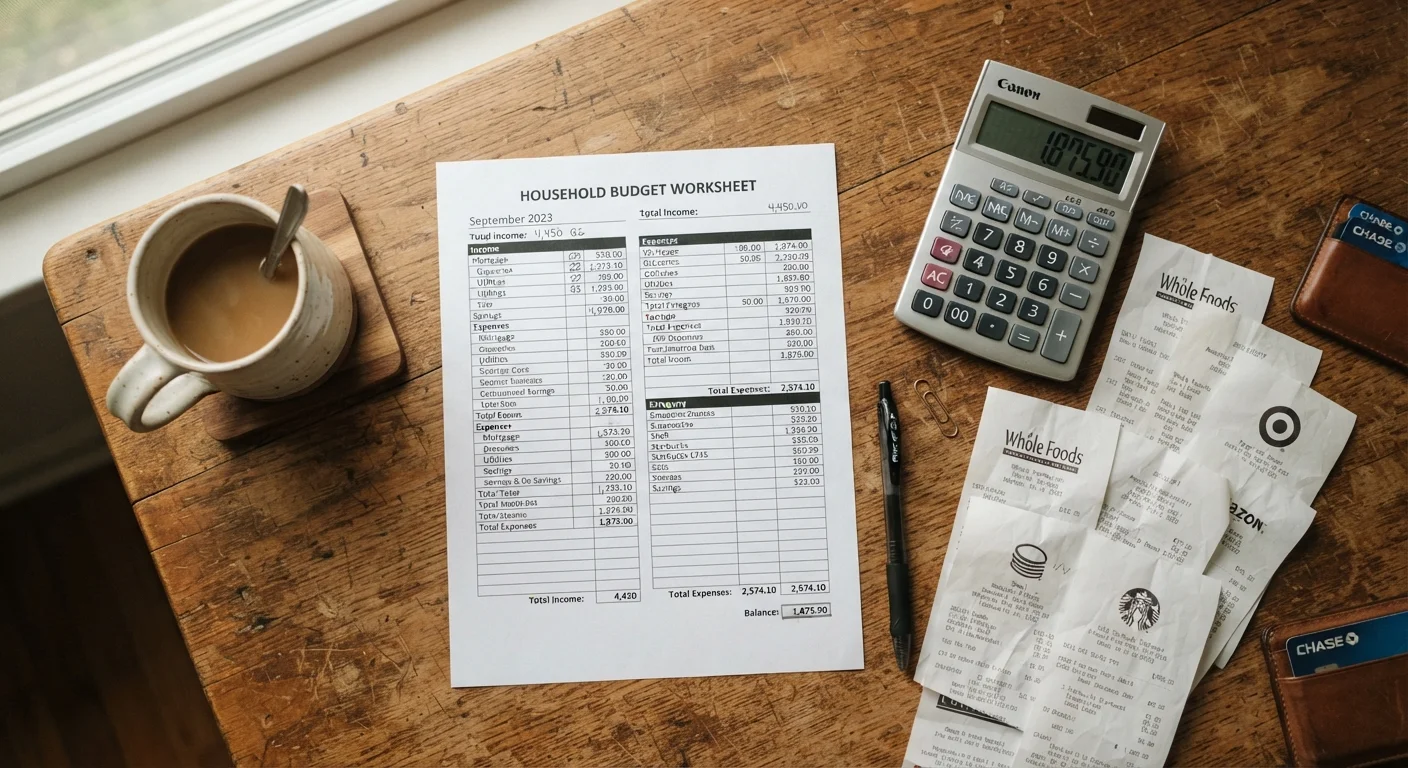
The Gap Between What You Think You Spend and What You Actually Do
Ask most people what they spend each month and they'll give a number — confidently. Ask them to categorize and total their last 90 days of transactions, and that number almost always climbs. Sometimes by hundreds of dollars.
This gap isn't carelessness. It's a predictable cognitive pattern. People remember large, intentional purchases and forget the smaller, automatic ones. A streaming renewal, a convenience fee, a third grocery run — none of these feel significant alone, but they accumulate into real money every month.
Understanding how spending categories actually break down is the first step toward closing that gap. Most budgets have the same broad structure — the numbers just vary by household.
~$1,500
Average monthly food spending per US household
According to the U.S. Bureau of Labor Statistics Consumer Expenditure Survey, food consumed at home and away from home together account for a substantial share of household budgets.
33%
Share of income going to housing for many US renters
The U.S. Department of Housing and Urban Development considers households that spend more than 30% of gross income on housing to be 'cost-burdened,' a threshold many American renters exceed.
$200–$300
Estimated average monthly subscription spend per household
Multiple consumer surveys suggest US households routinely underestimate their active subscription costs, often by 40% or more when compared against actual account statements.
The Major Categories and What They Actually Cost
Housing is the anchor. Rent or mortgage, utilities, renter's or homeowner's insurance, and any maintenance costs routinely absorb 25–35% of take-home pay for American households. Because most of these are fixed monthly charges, people often feel their housing costs are under control — even when rate increases or utility spikes have quietly pushed the total higher.
Food is where estimates break down fastest. Groceries alone tend to run higher than expected, but when delivery markups, restaurant tabs, and workplace lunches get added in, the real total often surprises. The cumulative effect of small daily food habits — a coffee here, a convenience purchase there — is one of the most underappreciated budget factors.
Transportation includes more than a car payment. Insurance premiums, fuel, parking, tolls, registration, and periodic maintenance all belong in this category. Households that only count their loan payment routinely understate transportation costs by $200–$400 per month.
Subscriptions and recurring services deserve their own line. Streaming platforms, cloud storage, fitness apps, news memberships, software licenses — each may seem negligible. Together they can easily reach $100–$300 per month. Many households are paying for services they rarely or never use. Finding and evaluating forgotten subscriptions is one of the highest-yield audits a household can do.
Fixed vs. Variable: Why the Distinction Changes Your Strategy
Not all monthly costs behave the same way, and that distinction matters practically. Fixed and variable expenses require different strategies — fixed costs are more stable but take longer to reduce; variable costs are more flexible and easier to adjust month to month.
Fixed expenses — rent, insurance, loan payments — demand negotiation or structural changes (refinancing, relocating, consolidating) to move the needle. Variable expenses — dining, entertainment, impulse purchases — can be adjusted immediately with behavioral changes. Most people trying to free up monthly cash flow will find more leverage in their variable spending, at least in the short term.
Treat Annual Charges as Monthly Costs
Divide every annual subscription, insurance premium, or membership fee by 12 and include that monthly average in your budget. This prevents annual charges from feeling like unexpected expenses and gives you a more accurate picture of your true recurring obligations.
Irregular expenses are a third category that most budgets ignore: car repairs, medical co-pays, annual insurance premiums, holiday spending. Because these don't appear every month, they tend to be excluded from estimates — then feel like emergencies when they arrive. Smoothing these into a monthly average is a more honest way to budget.
How to Build an Accurate Picture — Not Just a Better Guess
The only reliable way to know where your money goes is to look at where it actually went. Pull 60–90 days of statements from every account — bank accounts, credit cards, payment apps — and categorize every transaction. Budgeting tools can accelerate this, but manual review tends to surface things automated tools miscategorize.
Once you have a real baseline, building an accurate picture of your true cost of living becomes possible. From there, a structured monthly review helps you catch drift before it compounds. The Monthly Budget Health Check is a practical tool for doing exactly that — turning a one-time audit into a regular habit.
What Counts as a 'Monthly Expense'?
For budgeting purposes, it helps to include any cost that recurs within a 12-month window — even if it doesn't appear every month. Car registration, annual software renewals, and seasonal utility spikes are all real monthly costs when averaged over the year. Budgets that only account for what hits the account this month tend to systematically understate the true cost of living.
This article is for general informational and educational purposes only and does not constitute personalized financial advice. Readers should consult a qualified financial professional for guidance tailored to their individual circumstances.