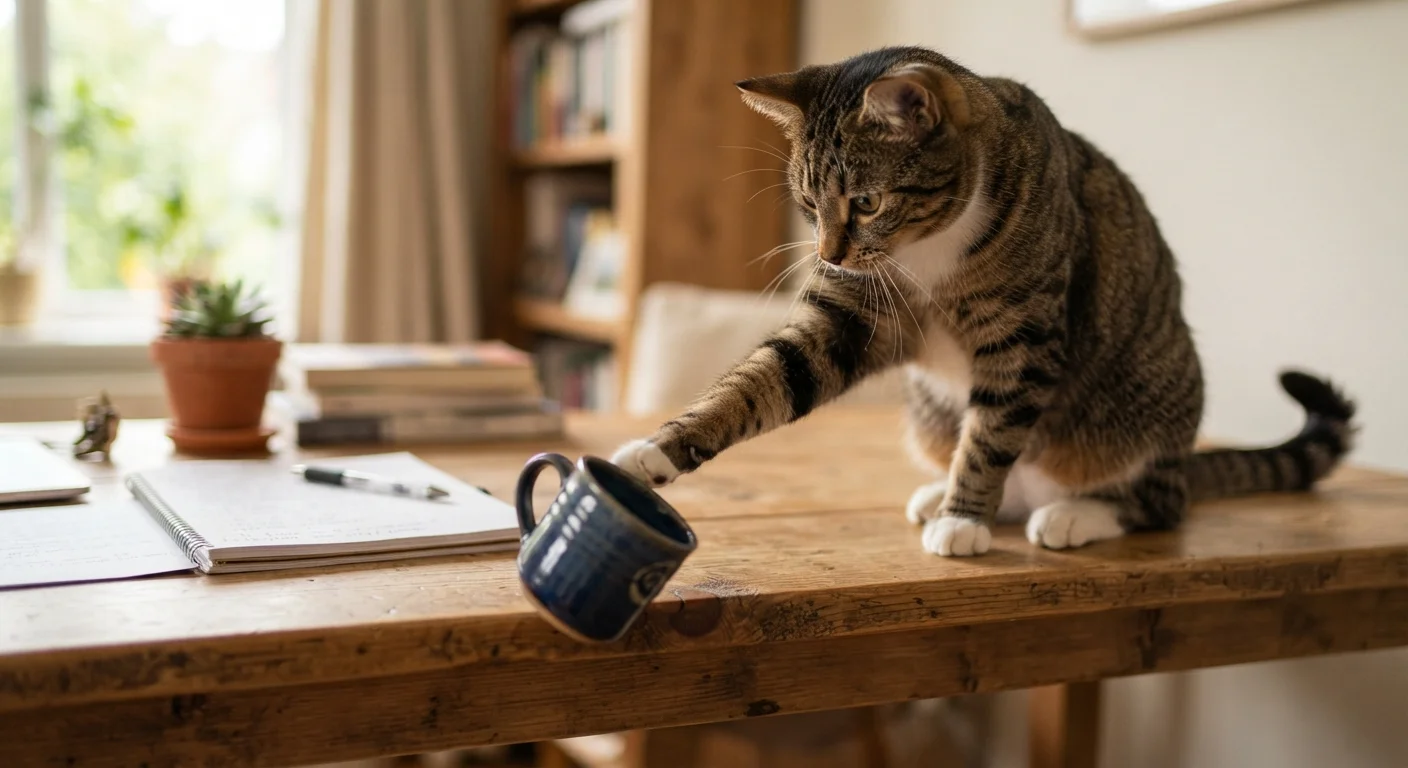
The Predatory Brain Behind the Behavior
To understand why your cat nudges your water glass off the counter, start with how cats are wired. Domestic cats retain the full predatory toolkit of their wild relatives. When a cat pats at a stationary object, it is running through an instinctive prey-assessment sequence — essentially asking, Is this thing alive? Will it move if I prod it?
Small animals like mice don't sit perfectly still. They twitch, dart, and react. Cats have evolved to probe objects before committing to a pounce, which is why a resting pen or a glass of water can become irresistible. The moment that object slides, tips, or falls, the cat receives a burst of sensory feedback that feels instinctively rewarding.
This is not a learned bad habit — it is hardwired behavior being expressed in a domestic environment. Understanding that distinction helps owners respond more effectively rather than with frustration.
“Cats are not mysterious — they are just speaking a language most people haven't been taught to read. Almost every behavior that frustrates an owner has a logical explanation rooted in feline biology or communication.”
— Dr. John Bradshaw, Anthrozoologist and author of 'Cat Sense'
Boredom and the Under-Stimulated Indoor Cat
A cat that has exhausted its mental and physical energy through play is far less likely to go looking for stimulation on your bookshelf. Object-knocking spikes noticeably in cats that lack adequate daily enrichment — and for many indoor cats, that gap is real.
Indoor cats don't have access to the sensory variety of the outside world: shifting smells, moving prey, varied terrain. Without outlets, they redirect natural urges toward whatever is available. Your countertop becomes a hunting ground, and the objects on it become surrogate prey.
Match Playtime to Hunting Patterns
Cats are most active at dawn and dusk — times that align with natural hunting cycles. Scheduling interactive play sessions during these windows gives cats an appropriate outlet for predatory energy and can reduce restless behaviors like object-knocking later in the day. Even 10 minutes of focused wand-toy play can make a noticeable difference.
If you have a solo indoor cat, this context matters a great deal. Our guide on keeping an only cat mentally stimulated offers evidence-backed enrichment strategies that address exactly this kind of restlessness.
When It's Really About Getting Your Attention
Cats are skilled observers of cause and effect. If knocking a pen off the desk once caused you to leap up, say their name, and redirect your full attention toward them — congratulations, you've trained your cat to knock things off the desk.
This is one of the most common drivers of persistent object-pushing in adult cats: it works. Your reaction — even a frustrated one — is a form of social engagement, and social engagement is what the cat wanted. Over time, the behavior becomes a reliable tool in the cat's communication repertoire.
Punishment Rarely Changes This Behavior
Scolding or startling a cat for knocking things over typically increases stress without addressing why the behavior is happening. Cats do not connect after-the-fact reprimands with the action you want to discourage. Redirecting attention before the behavior occurs — and staying calm when it does happen — is a more effective long-term approach, according to most animal behavior guidance.
Understanding this loop is the first step toward changing it. Calm, consistent responses — ideally combined with proactive play before your cat feels the need to demand attention — are more effective than punishment, which typically escalates anxiety without addressing the underlying need. For a broader look at what your cat's actions are really communicating, see our guide to reading cat body language.
What You Can Actually Do About It
Reducing unwanted object-knocking involves addressing the root cause rather than just protecting your belongings. A few approaches consistently supported by feline behaviorists:
- Schedule daily interactive play. Two 10–15 minute sessions with a wand toy or similar interactive tool can substantially reduce attention-seeking and predatory restlessness.
- Reduce the reward. If you react minimally and calmly when objects get knocked over, the behavior becomes less reinforcing over time.
- Offer sanctioned outlets. Puzzle feeders, cat trees with textured surfaces, and crinkle toys give cats appropriate objects to investigate and manipulate.
- Clear high-value targets. Items that are fragile, dangerous, or particularly prone to falling are best moved out of reach entirely rather than left as a test of willpower.
If you're a new cat owner still figuring out what a stimulating environment looks like, our guide for first-time cat owners covers the essentials of setting up your home in a way that works for both of you.
74%
Indoor cats showing boredom-related behaviors
A commonly cited figure in feline behavior literature suggests a majority of exclusively indoor cats display at least one behavior linked to under-stimulation, including repetitive object interaction.
2×
Reduction in attention-seeking with daily play
Feline enrichment research consistently shows that structured daily play sessions can meaningfully reduce demand behaviors in domestic cats, though individual results vary.